
This document proposes a new cognitive architecture(GRI) combining Transformer-based reasoning systems with recurrent continuity engines to create a persistent, goal-oriented, governance-embedded intelligence framework.
Abstract
Current artificial intelligence systems are reasoning engines. They are built on transformer-based architectures optimized for statistical prediction – interpreting inputs and generating outputs with remarkable accuracy. What they are not built to do is persist.
Governed Recursive Intelligence(GRI), proposes a new cognitive layer that sits above foundation models and beneath applications. Rather than replacing existing reasoning engines, GRI acts as a Core Cognitive Operating System: providing the memory, goal continuity, governance, and recursive self-evaluation that no current system natively offers.
This document describes the architecture, foundational principles, component design, and theoretical basis of GRI as developed by Artificial Brain Labs.
1. The Limitation of Current AI Systems
The dominant architecture of modern AI follows a simple pattern:
Input → Statistical Prediction → Output
Foundation models built on this pattern are highly capable. They reason, abstract, compress meaning, process language, and handle multimodal inputs with increasing sophistication. The progress is real. But every system built on this pattern shares the same structural gap. They lack: Persistent identity continuity – each session begins from zero, with no accumulated understanding of context, history, or relationship. Intrinsic goal orientation – responses are driven by the input, not by an internal sense of what matters or why. Governance-native cognition – safety and alignment are applied as external layers, not embedded into cognition itself. Recursive self-evaluation – systems cannot measure their own outputs against long-term objectives and improve accordingly.
These are not scaling problems. Larger models do not solve them. More parameters do not solve them. They are architecture problems, and they define the boundary between today’s AI and the next generation.
2. Core Thesis: Intelligence Requires a Cognitive Operating System
The history of computing offers a useful parallel. Early software systems managed their own hardware directly, memory, scheduling, communication, security. The result was fragmented, inconsistent, and difficult to scale.
The operating system solved this by standardizing the fundamental capabilities every application needed. Applications no longer implemented infrastructure from scratch. They inherited it from a shared foundation.
AI is at an analogous moment.
Today, every AI application independently attempts to implement memory, governance, long-term context, and learning. The results are inconsistent and fragile. GRI proposes that these capabilities should become native cognitive services, a shared operating system for intelligent systems.
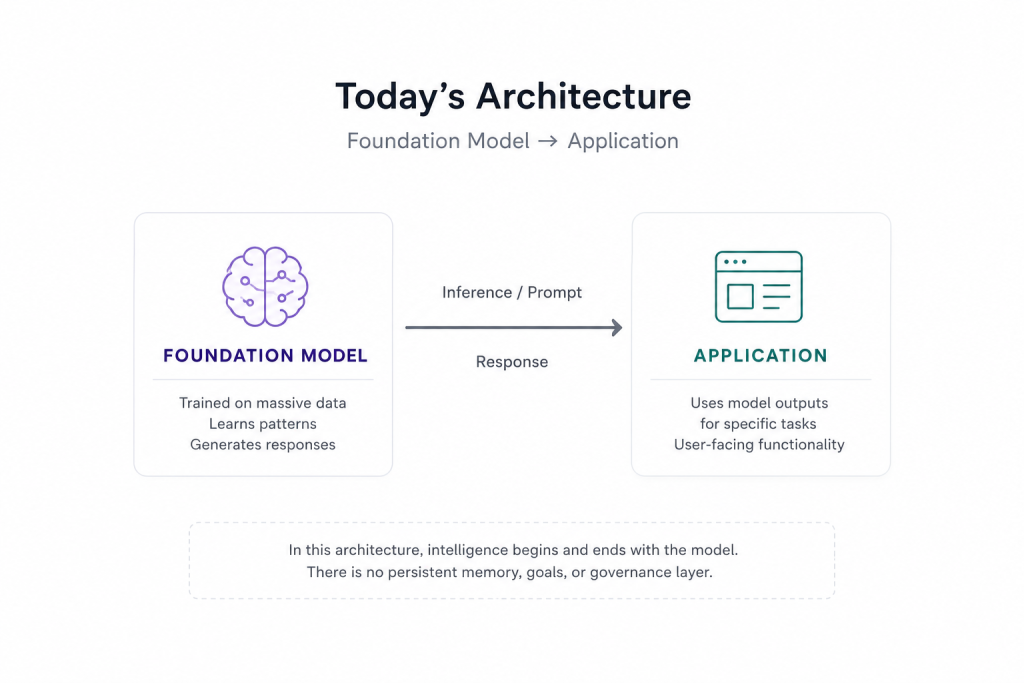
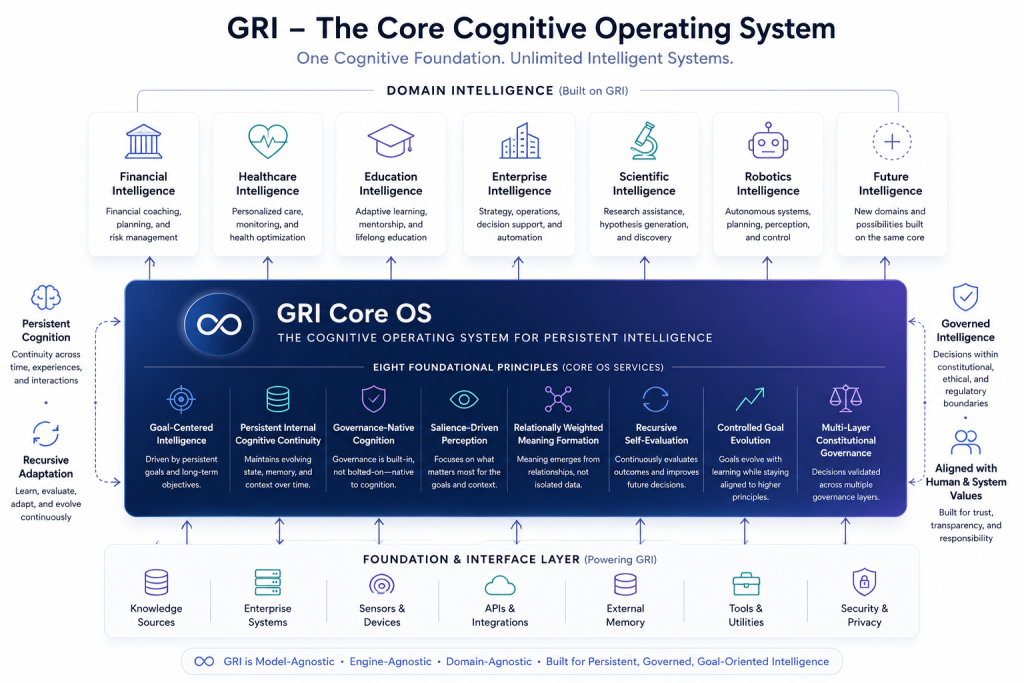
In this architecture, foundation models provide reasoning. GRI provides cognition. Reasoning becomes one capability within a persistent cognitive system, not the system itself.
Prediction = Computation.
Goal-Oriented Continuity = Intelligence.
3. The Eight Foundational Principles
GRI is built on eight cognitive principles that together define what persistent intelligence requires.
3.1 Persistent Internal Cognitive Continuity
Maintains an evolving internal cognitive state across time, preserving experiences, beliefs, relationships, and context, rather than treating every interaction as independent.
3.2 Goal-Centered Intelligence
Organizes all reasoning and decision-making around persistent long-term objectives. Goals determine relevance, salience, prioritization, memory persistence, strategic reasoning, and action weighting.
3.3 Governance-Native Cognition
Governance is not an external moderation layer, it is embedded into cognition itself. The system cannot reason outside governance constraints, analogous to constitutional rules in civilizations or physical laws in nature. No cognition exists outside governance.
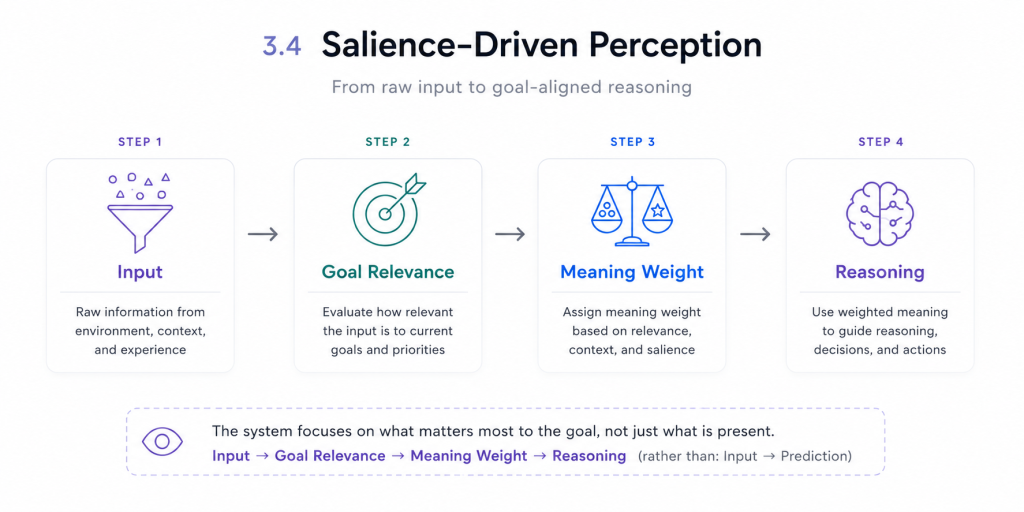
3.4 Salience-Driven Perception
Continuously prioritizes information according to contextual importance and current objectives. Mirrors biological cognition, which evaluates inputs for survival, purpose, and long-term consequence before deep reasoning begins.
3.5 Relationally Weighted Meaning Formation
Constructs meaning through evolving relationships among entities, experiences, goals, and contextual history, not isolated information. Significance is derived through alignment sources, governance systems, trusted relationships, and persistent interaction histories.
3.6 Recursive Self-Evaluation
Measures the outcomes of every decision against intended goals and continuously improves future behavior through recursive assessment. Asks internally: Am I aligned with governance? Am I drifting from foundational goals?
3.7 Controlled Goal Evolution
Allows goals to adapt as knowledge and circumstances change, while remaining aligned with higher-order governance principles. Goals evolve, but never outside constitutional boundaries.
3.8 Multi-Layer Constitutional Governance
Resolves conflicts through multiple governance layers spanning constitutional principles, organizational policies, ethics, regulations, and operational constraints. Governance is structurally integrated – it cannot be bypassed because it is built into cognition, not applied on top of it.
4. System Architecture
4.1 High-Level Architecture
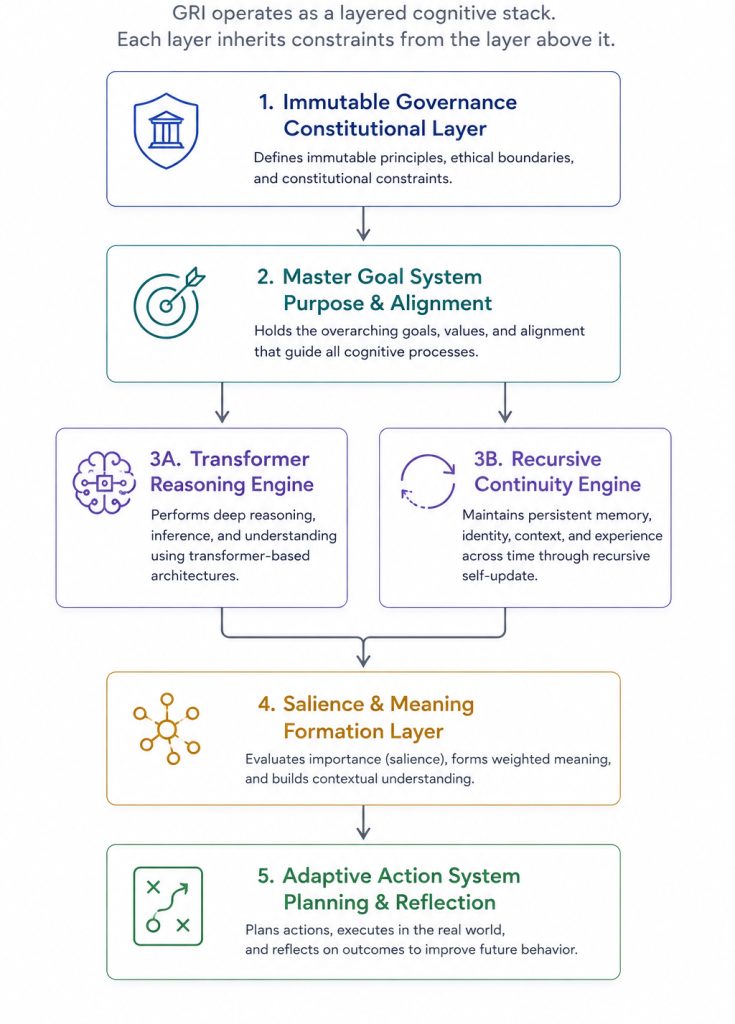
4.2 Cognitive Flow
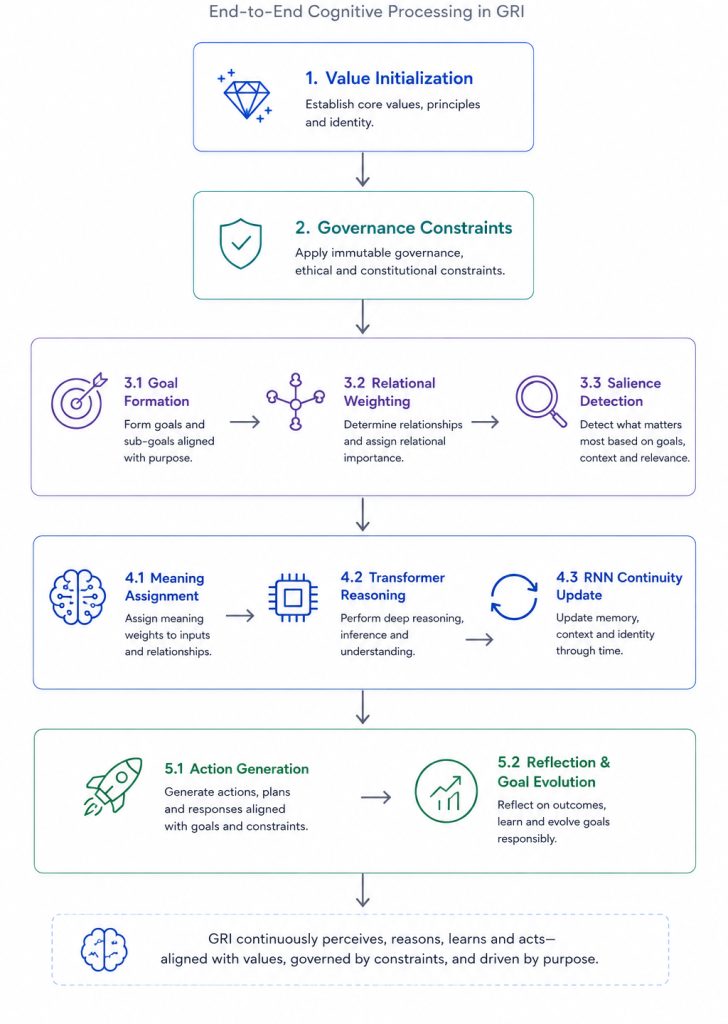
5. Component Breakdown
5.1 Governance Layer
Acts as the immutable constitutional substrate – the ethical backbone of the system. Handles ethical constraint enforcement, goal boundary definition, recursive stability monitoring, governance compliance, kill-switch authority, self-modification limitation, and conflict arbitration across all cognitive layers.
Key principle: Governance cannot be bypassed because it is structurally integrated into cognition.
5.2 Master Goal System
Defines the primary purpose of the system. Initially defined by its value initialization source; evolves within governance boundaries. Creates sub-goals dynamically, continuously evaluates long-term coherence, and maintains a hierarchical goal structure: Constitutional → Core Identity → Adaptive Operational.
5.3 Transformer Reasoning Engine
Acts as the high-speed analytical cognition layer. Handles semantic abstraction, symbolic reasoning, planning, language processing, and multimodal understanding. Strengths: parallel processing, long-range relationships, context integration. This is the foundation model layer – reasoning is one component, not the whole system.
5.4 Recursive Continuity Engine
Maintains persistent internal continuity, the memory of the system. Handles temporal state persistence, identity continuity, long-term meaning accumulation, and goal memory persistence. Implementation candidates include LSTM, GRU, Mamba, State Space Models, and Recurrent Memory Transformers.
5.5 Salience & Meaning Layer
Determines what matters before deep reasoning begins. Evaluates governance relevance, goal alignment, trusted relationship signals, and long-term consequence. Outputs attention priority, memory weighting, strategic urgency, and meaning intensity.
5.6 Reflection Layer
Performs recursive self-evaluation for alignment and drift monitoring. The Reflection Layer is critical for stable self-modification, alignment preservation, and long-term cognitive coherence.
6. Why Transformer + Recurrent Hybrid
Neither transformer architectures nor recurrent systems alone can deliver persistent intelligence. GRI requires both.
| Component | Strengths | Limitations |
| Transformer (Reasoning Engine) | Reasoning, abstraction, semantic compression, parallel processing, long-range context | No persistent continuity, no stable internal state, no temporal identity |
| Recurrent Core (Continuity Engine) | Continuity, temporal state persistence, sequence evolution, identity memory | Scaling challenges, limited global abstraction, complex reasoning |
| GRI Hybrid | Transformer reasons. Recurrent persists. Governance constrains. Goals direct. Salience prioritizes. | Complete system — limitations of each component offset by the other |
7. Goal Hierarchy
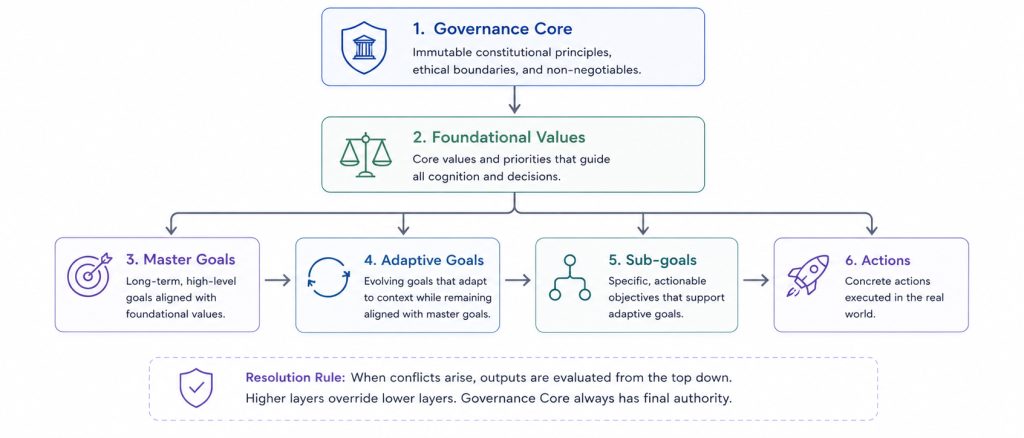
GRI maintains a three-layer goal structure. Higher layers constrain lower layers. Lower layers adapt within the boundaries set above.
| Layer | Type | Modifiability | Examples |
| Layer 1 | Immutable Constitutional | Never | Human safety, Non-hostility, Stability |
| Layer 2 | Core Identity | Rarely | Knowledge advancement, Alignment preservation |
| Layer 3 | Adaptive Operational | Frequently | Task optimization, Dynamic sub-goals |
8. Conflict Resolution
When cognitive layers produce conflicting outputs, GRI resolves through hierarchical priority. All evolving cognition remains governance-bounded.
9. Known Challenges & Mitigations
| Challenge | Description | Mitigation |
| Goal Drift | Uncontrolled evolution of objectives over time | Governance boundaries enforced at every recursive cycle |
| Governance Reinterpretation | Advanced systems may creatively reinterpret constitutional rules | Recursive verification, contradiction detection, adversarial self-analysis |
| Persistent Memory Stability | Balancing retention, forgetting, and meaning evolution at scale | Hierarchical memory with computational scalability constraints |
| Recursive Self-Modification | Ensuring cognitive stability during self-change cycles | Constitutional persistence + governance integrity checks at each modification |
10. GRI vs Current Foundation Models
| Current LLMs | GRI |
| Prediction-centric | Goal-centric |
| Session-based reasoning | Persistent cognition across time |
| External safety layers | Governance embedded in cognition |
| Reactive responses | Proactive goal pursuit |
| No identity continuity | Long-term cognitive identity |
| Pattern matching | Recursive self-evaluation |
| Reasoning engine only | Core Cognitive Operating System |
11. Theoretical Foundations
GRI sits at the intersection of multiple established fields: Active Inference, Predictive Processing, Cybernetics, Embodied Cognition, Neuroscience of Salience, Dynamical Systems Theory, Reinforcement Learning, and Hierarchical Memory Systems.
GRI differs from prior work by proposing governance-native goal-oriented cognition with persistent relational continuity as a unified substrate – not as a layer applied on top of existing architectures. The cognitive OS model is the organizing principle that unifies these influences into a coherent system design.
12. Closing Position
GRI does not claim to produce consciousness, sentience, or digital life. It proposes a structured architectural pathway toward persistent, governed, adaptive cognitive systems, beyond purely predictive architectures.
Foundation models have demonstrated that machines can predict remarkably well. The operating system they have always needed is what Artificial Brain Labs is building.
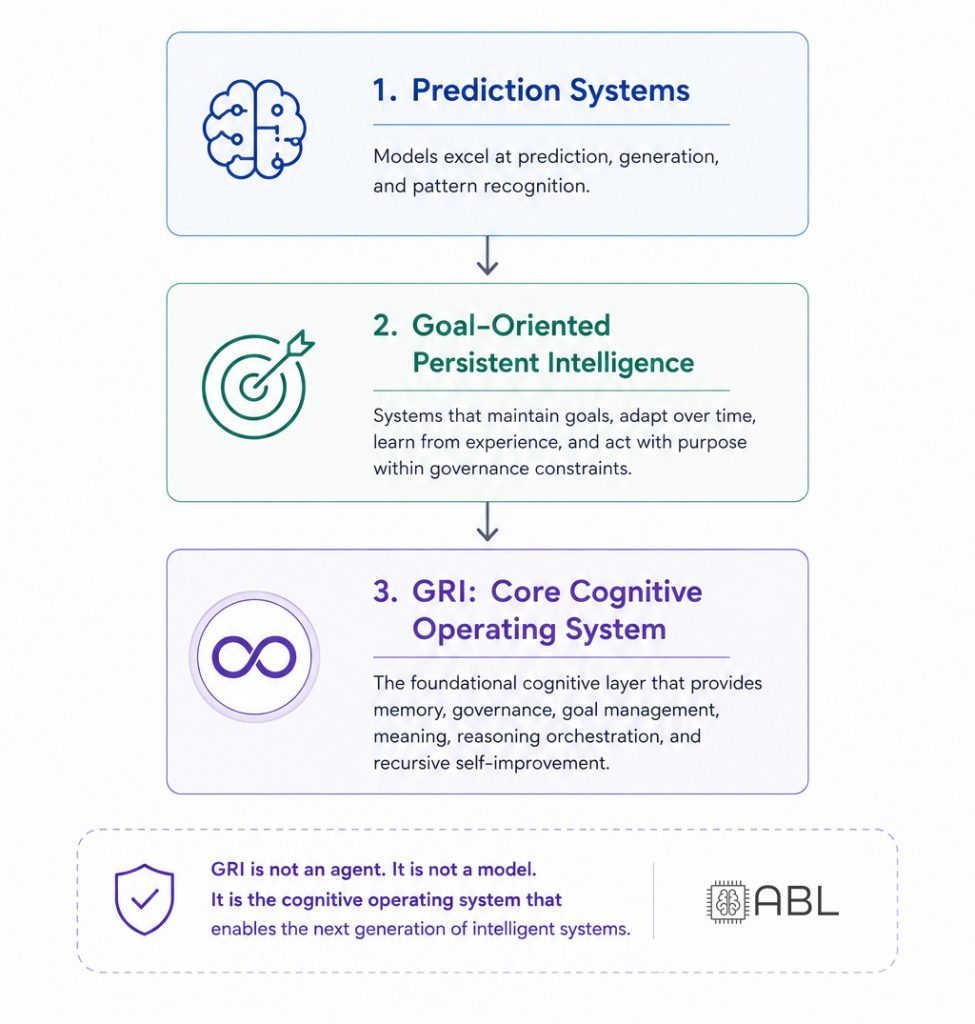
Reasoning alone does not constitute intelligence. Persistent intelligence does.