GRI Whitepaper – Self-Actualization as the Constitutional Master Goal of Persistent Intelligence

A Foundational Principle for Governed Recursive Intelligence (GRI) Author: Purnendu BalaChief Architect, Artificial Brain Labs Abstract Artificial intelligence has made remarkable progress in prediction, reasoning, planning, and autonomous task execution. Yet today’s systems remain fundamentally task-centric. They solve problems, answer Continue Reading …

Chapter 1: The Prediction Era

Previous Read – From Prediction to Purpose: Governed Recursive Intelligence (GRI) as a Framework for Goal-Oriented Persistent Cognitive Systems 1.1 Introduction Artificial Intelligence has undergone several transformative waves over the past seven decades. Each generation has introduced increasingly powerful methods Continue Reading …

From Prediction to Purpose: Governed Recursive Intelligence (GRI) as a Framework for Goal-Oriented Persistent Cognitive Systems

A Proposal for the Next Evolution of Artificial Intelligence Beyond Prediction-Based Generative Models Executive Summary Artificial Intelligence has progressed through several transformative stages – from rule-based expert systems to statistical machine learning, deep learning, large language models (LLMs), and, most Continue Reading …

Governed Recursive Intelligence(GRI) – A Core Cognitive Operating System for Persistent Intelligence – ABL’s Native AI Architecture

This document proposes a new cognitive architecture(GRI) combining Transformer-based reasoning systems with recurrent continuity engines to create a persistent, goal-oriented, governance-embedded intelligence framework. Abstract Current artificial intelligence systems are reasoning engines. They are built on transformer-based architectures optimized for statistical Continue Reading …

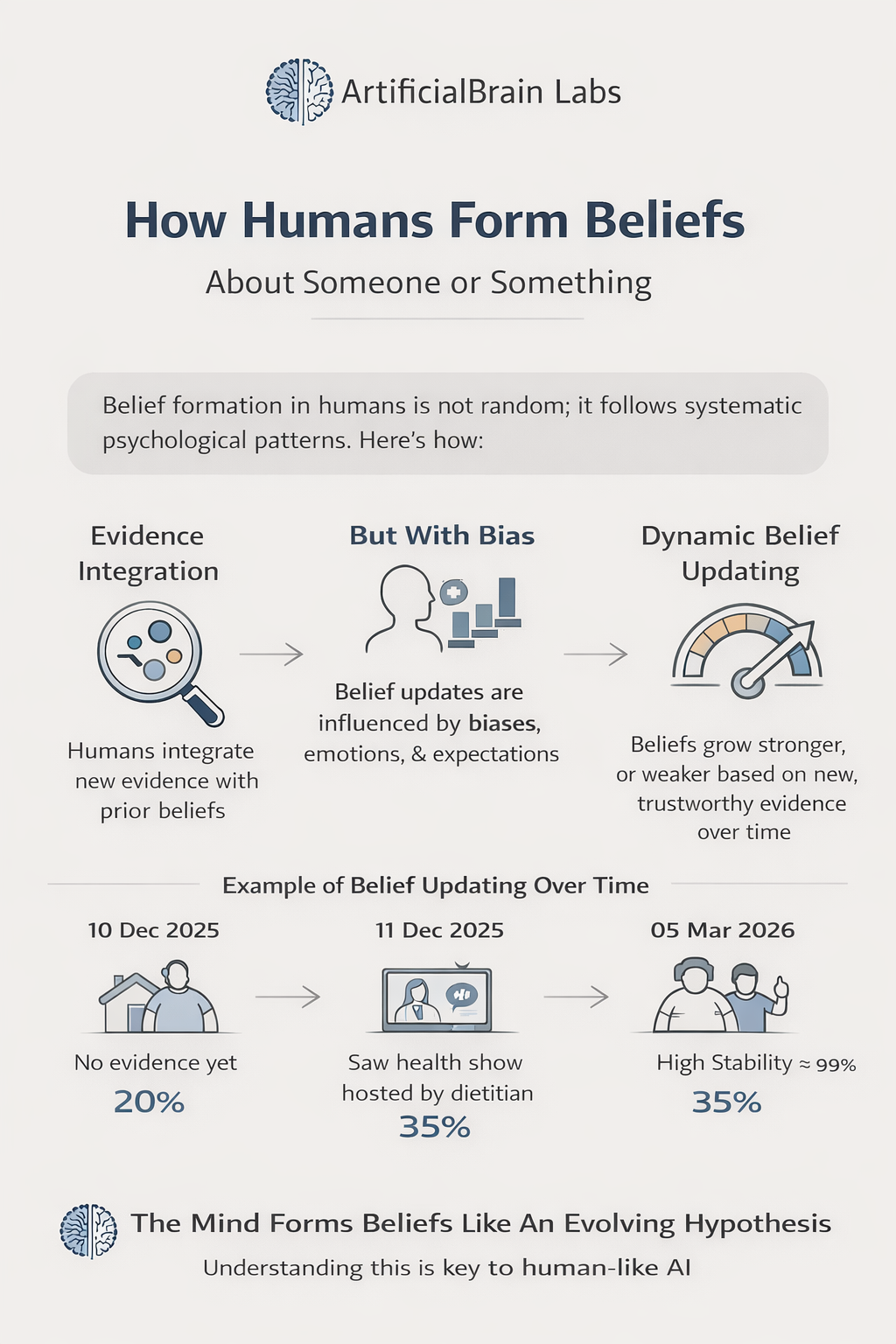
How Humans Form Beliefs About Someone or Something -A Psychology- and Biology-Grounded Perspective Toward Belief-Aware Artificial Intelligence

Introduction Human belief formation is not random. Decades of research in psychology, neuroscience, and cognitive science show that beliefs emerge through systematic, measurable processes that integrate evidence, prior expectations, emotional context, and lived experience. While human belief updating often resembles Continue Reading …