
QICA: Quantum-Inspired Cognitive Architecture by Artificial Brain Labs.
PPGN Model – Probabilistic & Priority-Gated Neuron
Executive Summary
Contemporary artificial intelligence systems demonstrate remarkable performance in pattern recognition and prediction, yet they remain fundamentally limited in their ability to maintain coherent internal beliefs, reason under deep uncertainty, and adapt meaningfully across contexts. Scaling model size or data volume has improved surface-level capabilities, but has not resolved underlying architectural gaps related to cognition, belief formation, and decision stability.
This whitepaper introduces QICA (Quantum-Inspired Cognitive Architecture), a conceptual framework for building AI systems around explicit belief states, structured uncertainty, and priority-regulated information flow. QICA does not rely on physical quantum computation. Instead, it adopts mathematical and conceptual tools inspired by quantum probability to model belief superposition, interference, and contextual collapse in a computationally tractable manner.QICA is positioned as an architectural research direction, not a finished product or a claim of artificial general intelligence. Its purpose is to provide a principled foundation for next-generation AI systems that must operate in uncertain, dynamic, and cognitively demanding environments, particularly where trust, interpretability, and long-horizon reasoning are essential.
Introduction
Despite breakthrough capabilities in generative modeling, current machine intelligence remains epistemically hollow. Systems predict but do not understand; they generate output without beliefs, context, or internal coherence. These limitations arise from the architectural design of modern AI: deep networks approximate functions but do not maintain memory, uncertainty structure, or long-term cognitive stability.
Biological cognition, in contrast, is driven by:
- probabilistic perception
- internal belief states
- salience and priority signals
- contextual modulation
- memory reconstruction
- contradiction handling
- goal-aligned reasoning
QICA aims to formalize these properties into a unified computational architecture. Rather than treating intelligence as emergent from scale, QICA asserts that intelligence must be architected, beginning with an explicit representation of belief, uncertainty, and cognitive fields.
Modern AI has no sense of:
- doubt (it does not internally question its own outputs)
- curiosity (it does not self-initiate learning or exploration)
- contradiction awareness (it does not realize when its answers conflict)
- judgment (it does not evaluate right/wrong based on internal values)
- context understanding (it uses patterns, but not real situational awareness)
- consequence awareness (it does not understand outcomes or stakes)
These are not engineering flaws. They are architectural absences.
Why Scale Is Not Intelligence
Increasing model size produces better imitation, not better understanding. Intelligence is not derived from compute power or parameter volume.
A larger library does not create a thinker.
A larger dataset does not create awareness.
Intelligence arises from structured representation, uncertainty modeling, memory, interpretation, emotions and goal formation.
QICA from Artificial Brain Labs is founded on the realization that cognition must be designed, not assumed to emerge, and we are working in this direction.
Human Cognition is Hybrid, Not Mechanical
Human intelligence is not singular. It arises from multiple systems operating simultaneously:
- Logical reasoning
- Emotional bias
- Cultural framing
- Personal experience
- Long-term memory
- Goal-driven behavior
Every decision humans make is influenced by memory, emotion, experience, and meaning, not logic or probability alone.
Remove emotion, and you remove priority.
Remove memory, and you remove identity.
Remove goals, and you remove direction.
Cognition is not computation. It is integration.
Modern cognitive science views the human mind as a collection of interacting subsystems rather than one “monolithic” intelligence.
These include:
Dual-process theory
Humans constantly switch between or blend these.
- Fast: emotional, instinctive
- Slow: analytical, logical
Emotional cognition
Emotion strongly shapes:
- decision-making
- risk perception
- memory
- attention
Social & cultural framing
Interpretation of events is heavily influenced by:
- norms
- learned values
- cultural knowledge
Experience-dependent learning
Personal experience forms schemas that guide:
- expectations
- intuition
- bias
Memory systems
Different types of memory
- Episodic
- Semantic
- Procedural
influence how we reason and behave.
Motivation & goals
Human decisions are shaped by
- Incentives
- Desires
- long-term strategies
- self priorities.
Human intelligence is multi-systemic, context-dependent, emotional, cultural, and memory-driven. It cannot be reduced to a single mechanism, unlike current AI, which mostly relies on probabilistic pattern-predictive modeling.
Why This Matters for Machine Intelligence
True intelligence cannot arise from text prediction alone.
Humans:
- reason under uncertainty
- evaluate emotionally
- interpret culturally
- learn experientially
- reflect internally
- choose purposefully
QICA is motivated by the view that advancing AI capability requires not only better learning algorithms, but new architectural abstractions that treat belief, uncertainty, and decision coherence as first-class design elements.
Design Principles of QICA
QICA is guided by the following principles:
- Belief as a First-Class Object
Internal belief states are explicitly represented, not implicitly embedded in weights or rules. - Uncertainty as Structure, Not Noise
Uncertainty is modeled as an intrinsic property of belief, not as an external error term. - Context-Sensitive Belief Evolution
Beliefs evolve differently depending on context, history, and priority. - Priority-Regulated Information Flow
Not all information is processed equally; salience and relevance dynamically gate computation. - Architectural Separation of Learning and Belief Dynamics
Learning mechanisms update parameters, while belief dynamics govern interpretation and action.
Related Work
Brain-Inspired Cognitive Architectures
Neurocognitive architectures such as SPAUN (Eliasmith et al., 2012) and the Human Brain Project (Amunts et al., 2016) simulate aspects of biological cognition but do not provide unified probabilistic belief fields.
Quantum-Inspired Cognition
Quantum probability models explain human decision interference effects more accurately than classical probability (Busemeyer & Bruza, 2012; Pothos & Busemeyer, 2020). These inspire QICA’s representation of coexisting belief superpositions.
Neuromorphic & Spiking Neural Models
Event-driven computation and local plasticity (Indiveri & Liu, 2015; Davies et al., 2018) mirror biological temporal processing. QICA extends this toward cognitive-level reasoning.
Bayesian & Predictive Processing Models
The Bayesian brain hypothesis (Knill & Pouget, 2004) and predictive coding frameworks (Clark, 2013; Friston, 2005) form strong theoretical support for belief-based inference systems.
How QICA Mirrors Human Thinking
| Human Function | QICA Mapping |
| Logical reasoning | Symbolic reasoning layer |
| Emotion & weighting | Cognitive Memory Tensor |
| Memory & identity | CMT + CPL |
| Uncertainty | Quantum cognition engine |
| Learning | Cognitive Plasticity Learning |
| Meaning formation | PPGN network |
| Adaptation | Neuromorphic intelligence |
| Biological behavior | CHN |
| Goal orientation | Policy & intent layer |
QICA is not software. It is cognitive design.
Comparison with Existing Architectures
| Architecture | Primary Strength | Key Limitation |
|---|---|---|
| ACT-R | Structured symbolic reasoning | Limited uncertainty modeling |
| SOAR | Goal-driven problem solving | Rigid belief updates |
| LIDA | Attention and global workspace | Weak formal belief representation |
| QICA | Coherent belief under uncertainty | Early-stage, requires validation |
QICA is not positioned as a replacement, but as a complementary architectural framework that can integrate with or extend existing systems.
Potential Applications
QICA is particularly suited for domains requiring:
- Decision-making under uncertainty
- Human-AI interaction with trust requirements
- Adaptive autonomous agents
- Research simulations of cognition
- Strategic planning in dynamic environments
It is not claimed as a general intelligence solution.
Cognition
Human thought violates classical probability.
Beliefs overlap.
Memories and emotions interfere.
Truth collapses contextually.
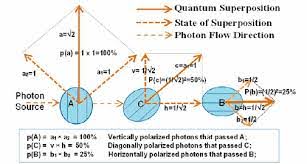
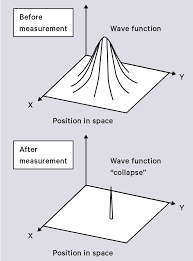
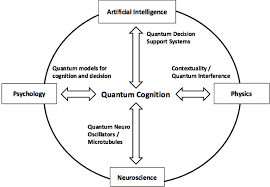
Human cognition does not operate through fixed classical logic. Instead, our thoughts often coexist, overlap, interfere, and shift depending on emotional state, cultural framing, memory, goals, and context. Quantum cognition models this by using probability amplitudes rather than rigid truth values.
In this framework, mental states are treated as superpositions of beliefs, not single, deterministic activations. When a person makes a decision, the mind performs a collapse, selecting one interpretation from multiple competing possibilities. This collapse is driven by context, relevance, emotion, and prior experience, rather than by strict rule-based reasoning.
QICA extends this idea by representing internal cognitive states as dynamic belief superpositions, allowing uncertainty, ambiguity, and multiple parallel interpretations to exist simultaneously. Here, uncertainty is not an error—it is a native computational feature, enabling more human-like reasoning, richer decisions, and context-sensitive understanding.
Neuromorphic Intelligence
Hardware That learn out of curiosity
Traditional computers execute instructions sequentially. Brains respond to events.
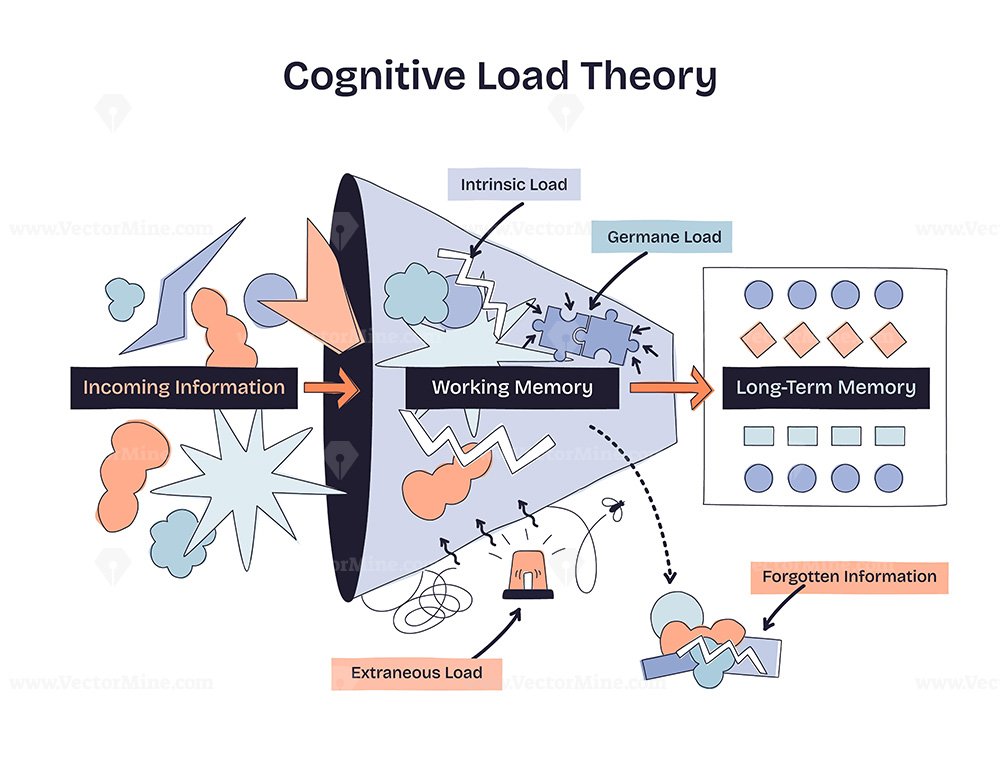
Curiosity is one of the major triggers in the human learning system. This response is closely linked to dopamine release and the brain’s novelty-detection circuits. When something new or surprising appears, the brain generates a dopamine-driven signal that helps evaluate whether the information is worth exploring or storing. The decision is influenced by factors such as past experiences, relevance, emotional significance, current goals and available cognitive resources. If the input is considered low-value or unnecessary, the brain deprioritizes or ignores it.
Neuromorphic systems introduce:
- spike timing
- local learning
- plasticity
- neural memory
- energy efficiency
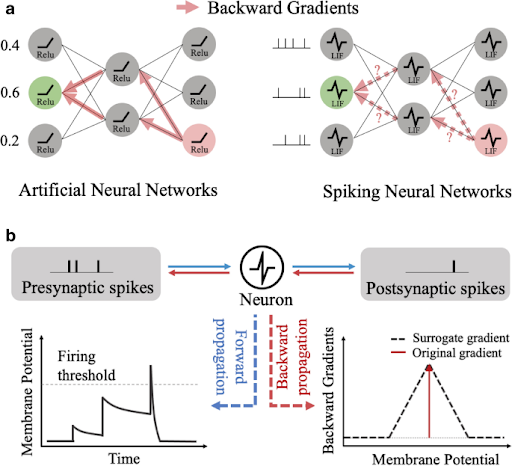
Neuromorphic computing abandons traditional sequential processing in favor of architectures modeled after neural biology. Information is transmitted through spikes, memory is fused with computation, and learning is localized and continuous. This produces systems that are energy-efficient, adaptable, and capable of real-time event processing. While conventional hardware scales computation, neuromorphic systems scale cognition. QICA leverages this property by placing cognition where silicon behaves more like living tissue than a digital machine.
Things to remember:
- Curiosity activates dopaminergic pathways (especially in the ventral striatum and ventral tegmental area).
- Novelty detection involves the hippocampus, amygdala, and prefrontal cortex.
- The brain acts as a priority-based filtering system, storing information only when it passes a “relevance threshold”.
ABL is Proposing PPGN Model
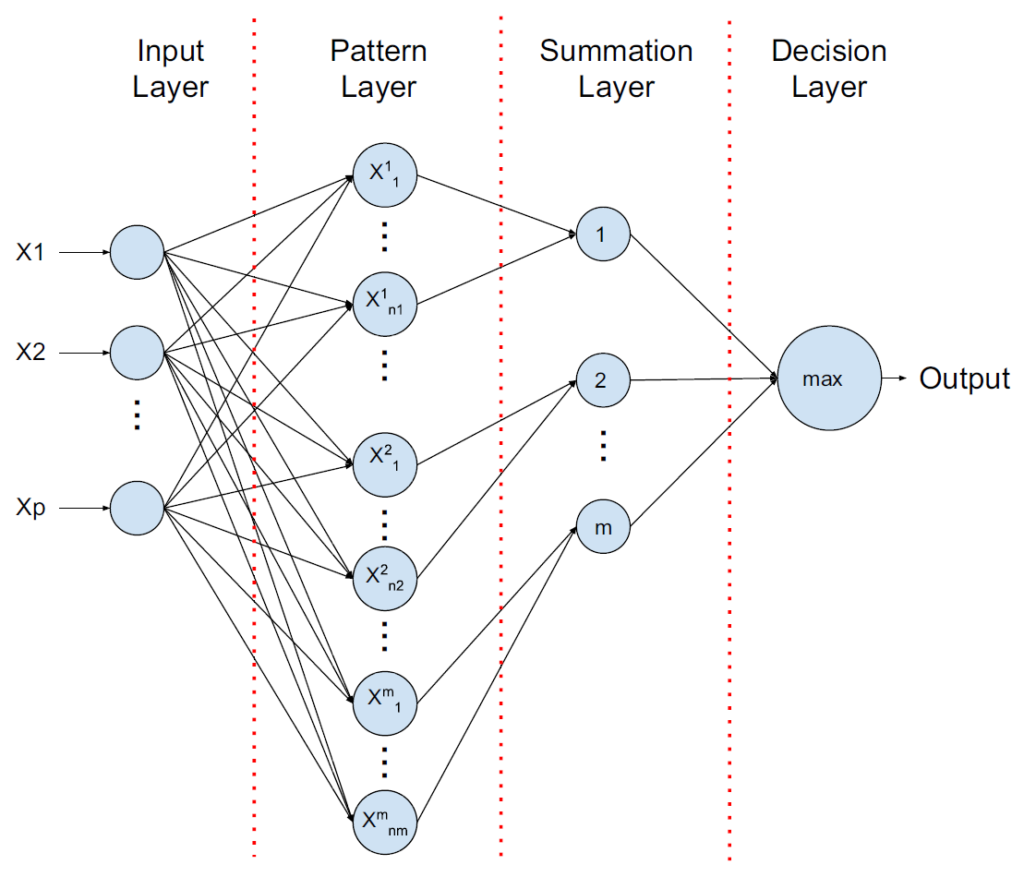
The Probabilistic & Priority-Gated Neuron(PPGN) is a foundational design shift. Instead of transmitting numeric activation values, PCNs communicate probability and priority fields. They represent uncertainty, meaning gradients, and cognitive influence rather than deterministic output. Learning reshapes belief distributions instead of adjusting weights alone. This allows cognition to emerge as a behavior of the system rather than being externally engineered through rules or datasets.
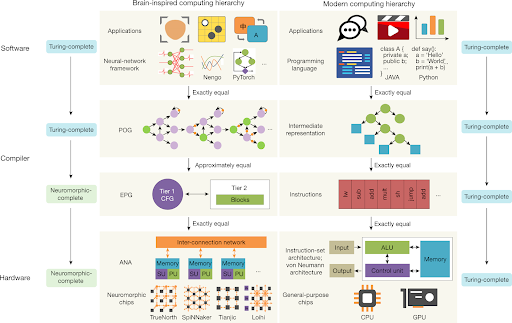
Neuromorphic hardware is the physical foundation of cognitive machines.
Traditional neurons output values. PPGNs emit beliefs.
Instead of: y = f(Wx + b)
QICA defines: ψ = F(curiosity, context, memory, goals, uncertainty)
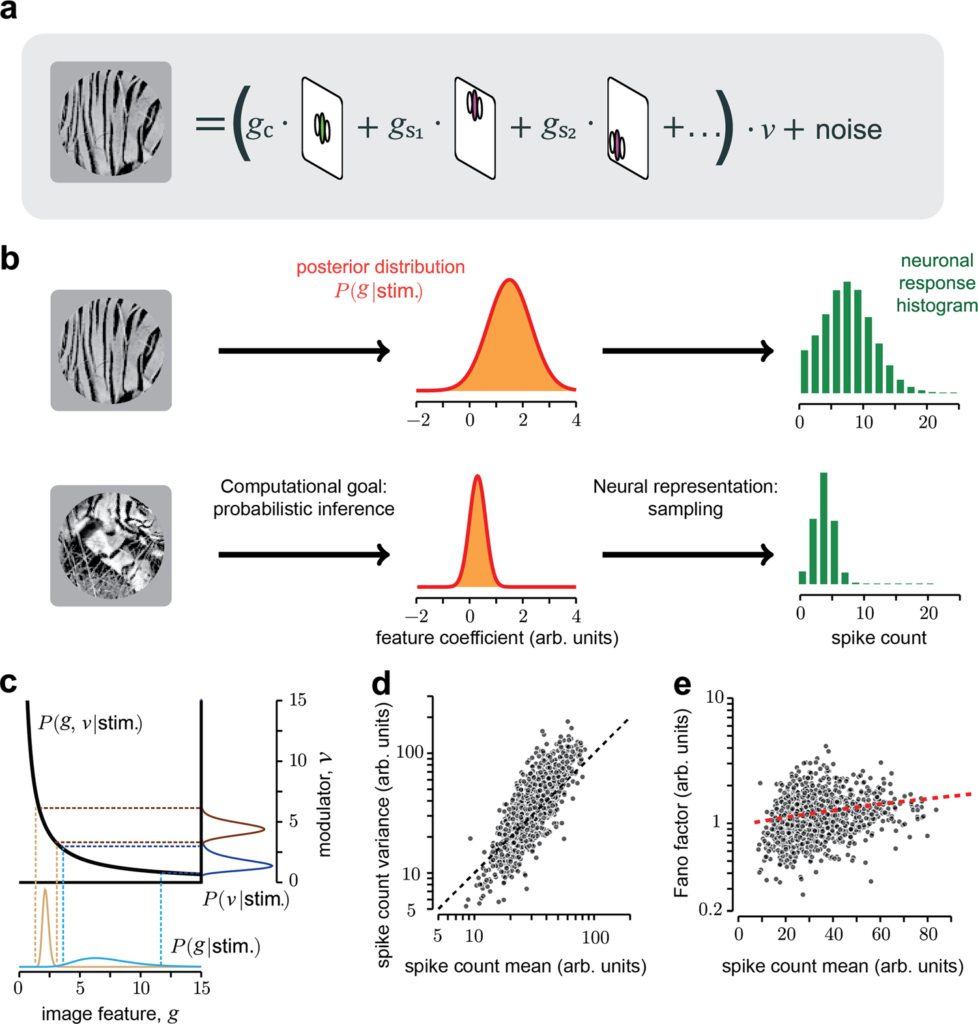
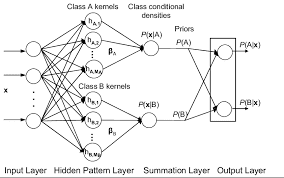
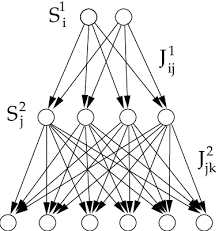
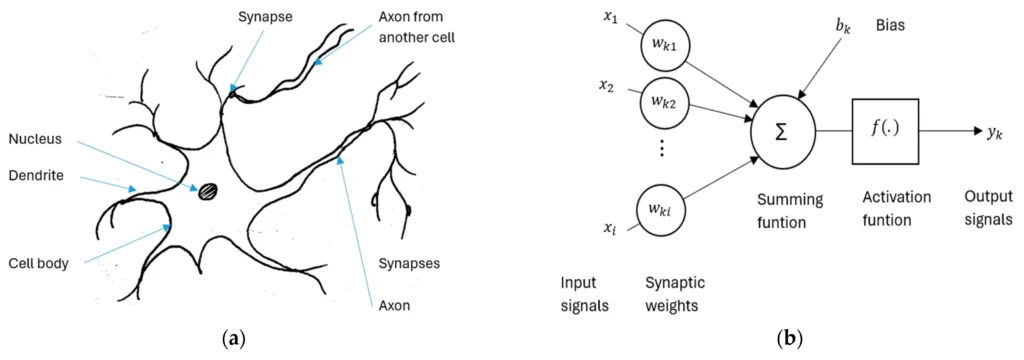
Learning reshapes probability, not parameters.
Cognitive Memory Tensor
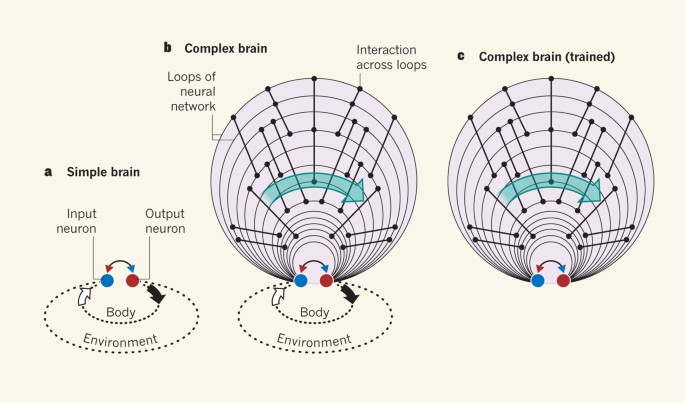
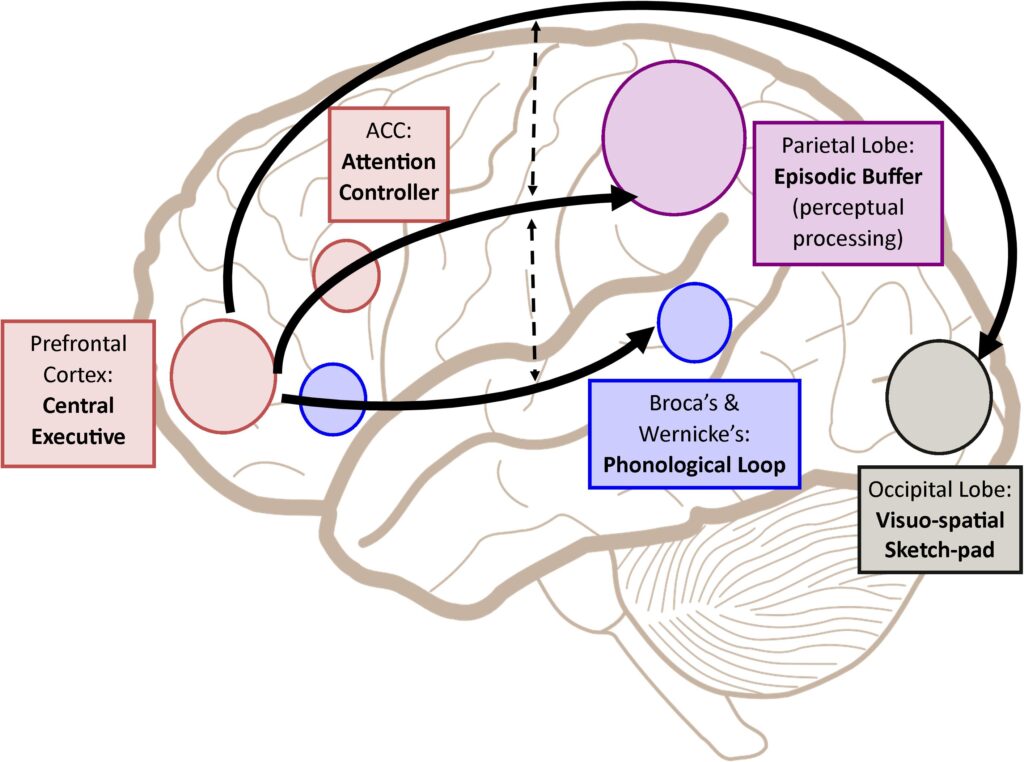
Memory is not a box. It is a probability field.
CMT stores:
- meaning
- emotion
- time
- goals
- confidence
- contradiction
Recall reconstructs memory rather than retrieving it.
Learning in QICA
Cognitive Plasticity Learning (CPL)
Learning in QICA does not revolve around minimizing numerical error like classical AI models. Instead, it focuses on stabilizing probabilistic belief states within a system that behaves more like a human cognitive architecture. Belief updates occur through Cognitive Plasticity Learning, where the goal is to maintain coherence across expectations, priorities, and contextual uncertainties.
Rather than forcing the model to match a target output, QICA reduces surprise by reshaping internal belief superpositions so they align with past experience, relevance signals, and contextual cues. This mirrors how human learning integrates logic, emotion, memory, cultural framing, and goal-driven behavior simultaneously.As belief states stabilize, the system becomes more resilient, context-sensitive, and internally consistent, qualities that classical optimization-based neural networks do not inherently possess. In QICA, learning is not overfitting; it is progressive refinement of probabilistic understanding, guided by prioritization, uncertainty, and cognitive relevance.
Cognitive Hybrid Neurons (CHN)
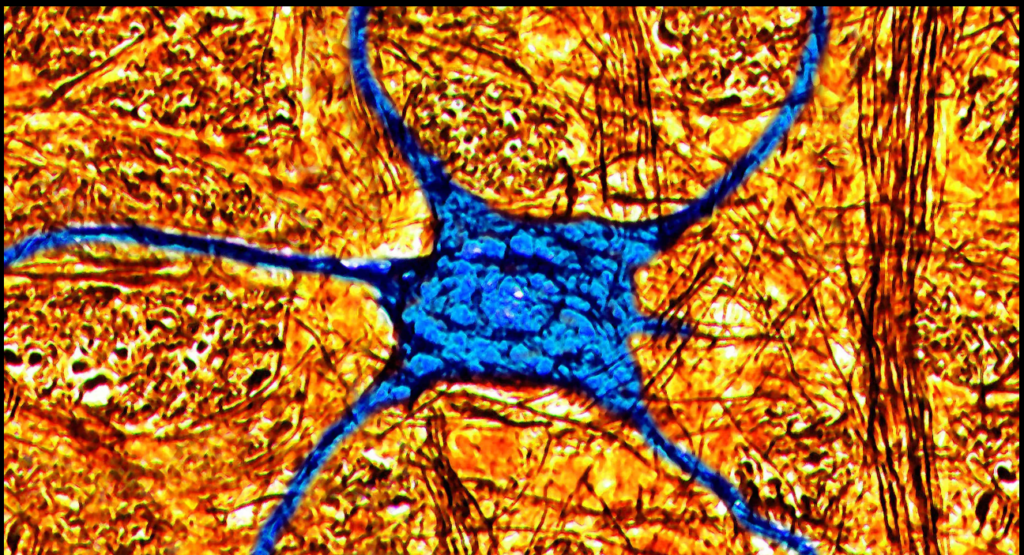
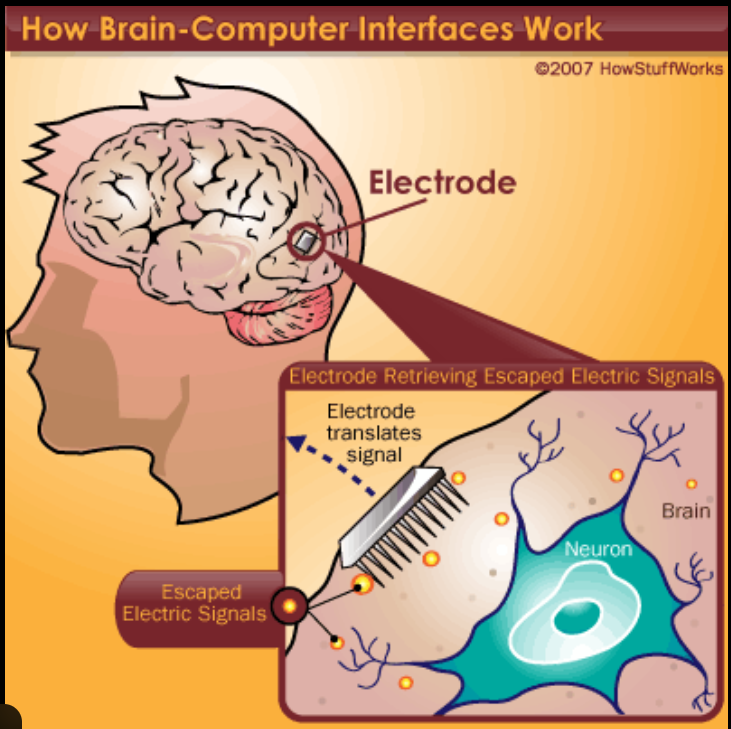
Biological neurons grown in laboratory environments demonstrate plasticity and adaptability beyond artificial systems. CHN explores the integration of living neural cultures with neuromorphic processors and quantum-inspired cognition engines. Biological tissue becomes a substrate for adaptive representation, while silicon provides scale and interpretability. CHN represents a future where intelligence may exist as a hybrid architecture, consisting of both organic and artificial components.
CHN proposes:
- biological cultures as adaptive memory
- neuromorphic interfaces as processors
- quantum cognition as controller
- symbolic logic as interpreter
QICA Architecture
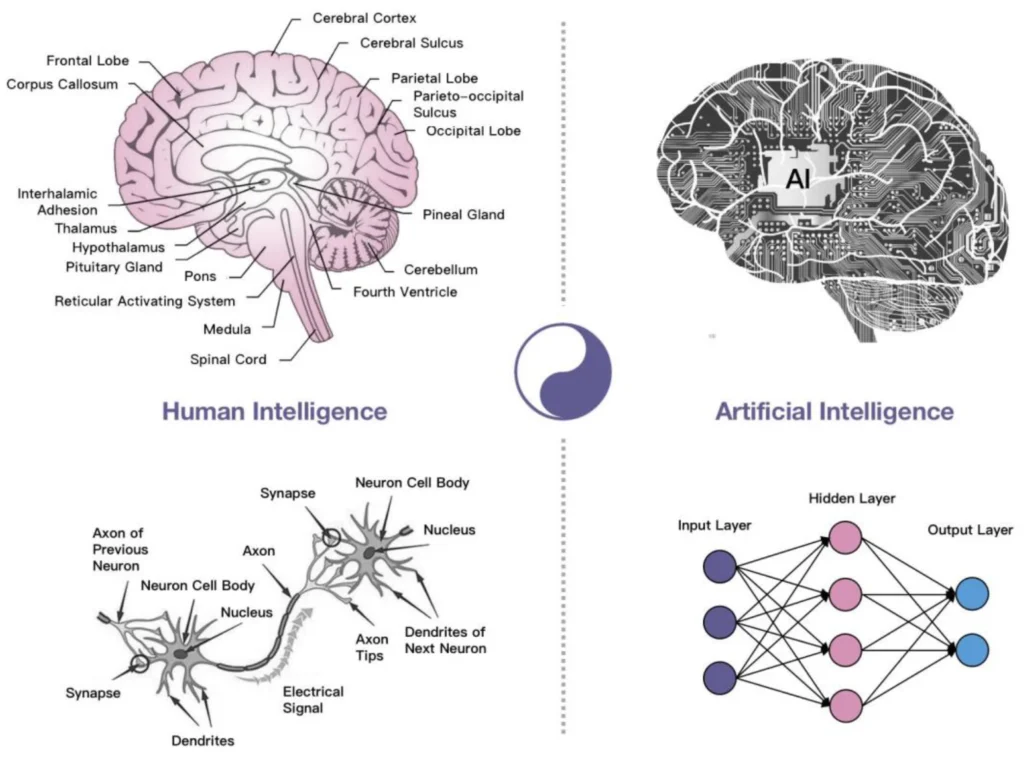
QICA integrates multiple layers of cognitive computation, combining symbolic reasoning, probabilistic neural networks, and quantum-inspired belief modeling to approximate human-like cognition.
1. Symbolic Reasoning Layer
- Handles structured knowledge, logic, and rule-based inference.
- Supports explicit reasoning over facts, constraints, and formalized relationships.
- Provides interpretability and high-level guidance to lower layers.
– [Grounded in cognitive architectures such as SOAR (Laird, 2012) and ACT-R (Anderson, 2007), providing explicit interpretability.]
2. Quantum Cognition Layer
- Models beliefs and internal states as superpositions, not deterministic activations.
- Decision-making emerges through collapse processes, where multiple competing interpretations converge under context.
- Incorporates uncertainty as a native feature, supporting reasoning in ambiguous, contradictory, or partially observed scenarios.
– [Based on evidence that human reasoning exhibits superposition and interference-like effects (Busemeyer & Bruza, 2012; Haven & Khrennikov, 2013).]
3. PPGN (Probabilistic & Priority-Gated Neuron) Network Fabric
- Implements neurons that encode probabilities and priorities simultaneously.
- Belief updates follow Cognitive Plasticity Learning (CPL), optimizing expectation coherence and uncertainty calibration rather than minimizing numeric error.
- Supports adaptive, resilient reasoning with stable internal states over time. [Priority modulation maps to neuromodulatory control systems such as dopamine and norepinephrine (Doya, 2002; Aston-Jones & Cohen, 2005).]
4. Neuromorphic Hardware Layer
- Provides physically plausible computation for PPGN networks.
- Exploits parallel, event-driven processing to mimic temporal dynamics of biological neurons.
- Enables low-latency, energy-efficient computation suitable for large-scale probabilistic inference. –[References state-of-the-art architectures (Davies et al., 2018; Furber et al., 2014) enabling event-driven cognition.]
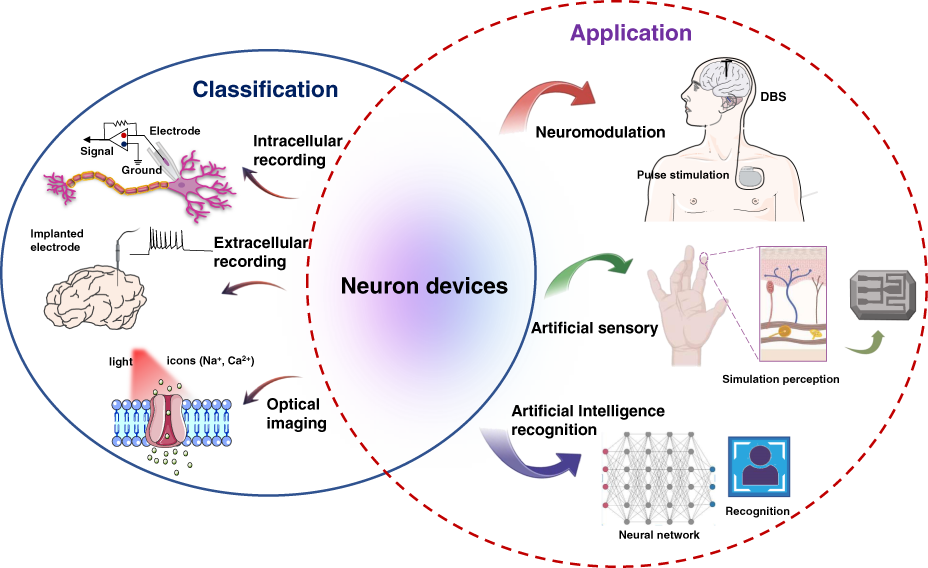
5. Biological Interface Layer
The Biological Interface Layer is the bridge between cognition and reality. Without it, QICA is an intelligent engine running in isolation. With it, QICA becomes a situated cognitive system, one that experiences, adapts, and forms purpose. [Grounded in embodied AI (Pfeifer & Bongard, 2006) and hybrid neuro-AI systems (DeMarse et al., 2001).]
CORE PURPOSE OF THE BIOLOGICAL INTERFACE LAYER
1. It Connects “Thought” to the Real World
This layer allows QICA to receive raw sensory input, not just sanitized data.
It can ingest:
- visual signals (cameras, vision systems)
- sound (microphones, auditory patterns)
- touch and motion (tactile sensors, robotics)
- physiological signals (EEG, EMG, biofeedback)
- human feedback (emotion, correction, guidance)
Without this layer, QICA only reasons abstractly.
With it, QICA experiences physically.
2. It Injects “Context” Into Thinking
Data alone is meaningless without context. It tells QICA: “This is happening now, in this environment, with this meaning.“
This layer injects:
- environmental state
- location awareness
- temporal signals
- human cues
- physiological conditions
Cognition without situational grounding becomes hallucination.
3. It Enables Novelty Detection
Real intelligence reacts to what it has never seen before. When QICA encounters something unfamiliar, this layer signals: “This matters. Learn this.”
This layer provides:
- anomaly detection
- surprise signals
- unexplained inputs
- uncertainty spikes
Novelty becomes fuel for learning.
4. It Creates Motivation & Direction
Traditional AI has no reason to care.
This layer introduces:
- reward signals
- discomfort feedback
- curiosity triggers
- emotional biasing
- attention priority
It does not ask: “Is this correct?” It asks: “Is this important?”
That shift creates goal-driven intelligence.
5. It Enables Biological Learning Structures (CHN – Cognitive Hybrid Neurons)
When biological neurons are present, this layer:
- controls stimulation
- routes neural feedback
- modulates plasticity
- manages safety thresholds
- forms memory associations
This allows: Hybrid cognition: living neurons + artificial reasoning.
| Without Biological Interface | With Biological Interface |
| Disconnected intelligence | Embodied mind |
| No awareness | Real-world grounding |
| Static knowledge | Experience-driven |
| No purpose | Goal-direction |
| No exploration | Curiosity |
| No embodiment | Internal “life” signals |
Mathematical Foundations
QICA treats intelligence not as a fixed computational process, but as a dynamic probabilistic system operating in belief space. Instead of modeling cognition as a deterministic function, QICA models it as a continuous evolution of internal states shaped by uncertainty, context, and experience. The mathematical foundation of this approach draws primarily from probability theory, Bayesian statistics, entropy dynamics, and field-based modeling.
Probability Dynamics
In QICA, internal system states are expressed as probability fields rather than numerical activations. Each cognitive unit, particularly within the PPGN network, represents a distribution over possible interpretations instead of a single output value. These distributions evolve continuously with input, memory, and feedback.
Rather than processing a fixed numerical signal, a PPGN evolves a probability waveform that reflects confidence, contradiction, and ambiguity. Interacting neurons do not exchange numbers, but probability mass. Reasoning becomes the flow and reshaping of probability across the network, similar to how energy propagates through a physical field.
Entropy and Uncertainty Regulation
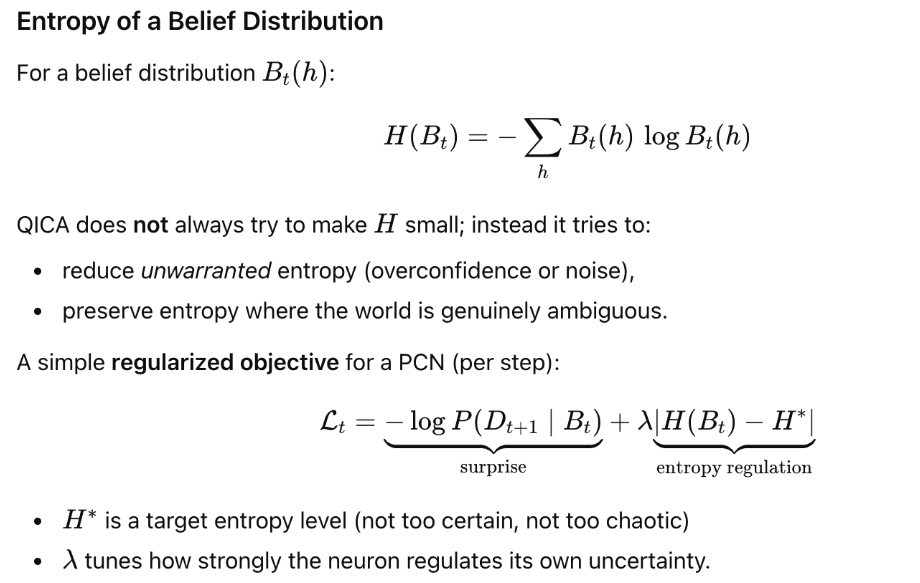
At the core of QICA’s learning system is entropy control. Entropy measures uncertainty.
Every belief has entropy associated with it:
- high entropy → confusion
- low entropy → certainty
Learning reshapes belief distributions by reducing unnecessary entropy while preserving flexibility where uncertainty is real and unavoidable.
Unlike classical AI, which eliminates uncertainty aggressively, QICA regulates it:
- uncertainty is maintained where information is incomplete
- overconfidence is actively suppressed
- stable beliefs emerge gradually
- contradictions remain visible instead of hidden
This allows the system to reflect real-world conditions more accurately than deterministic models.
Belief State Evolution
In QICA, internal reasoning is expressed as a series of belief state transitions.
A belief state represents the system’s internal view of reality at any given moment. Every input, memory reference, or action modifies the shape and stability of this state.
Beliefs evolve dynamically through:
- reinforcement (when evidence accumulates)
- decay (when certainty weakens)
- interference (when beliefs compete)
- contextual weighting (environment-dependent reshaping)
This makes cognition a temporal process, not a batch computation.
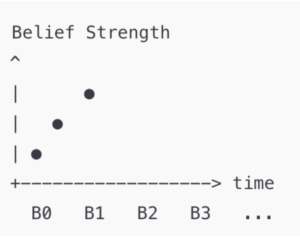
The system does not “store knowledge”, it stabilizes patterns of belief over time.
Belief Dynamics and Information Flow
Belief evolution in QICA proceeds through three stages:
- Initialization
Beliefs are initialized as broad distributions reflecting uncertainty. - Evidence Integration
Incoming information modifies belief amplitudes rather than forcing immediate selection. - Contextual Resolution
Under sufficient priority or decision pressure, belief states partially or fully resolve into actionable commitments.
This process allows QICA systems to remain stable under ambiguity while retaining the ability to act decisively when required.
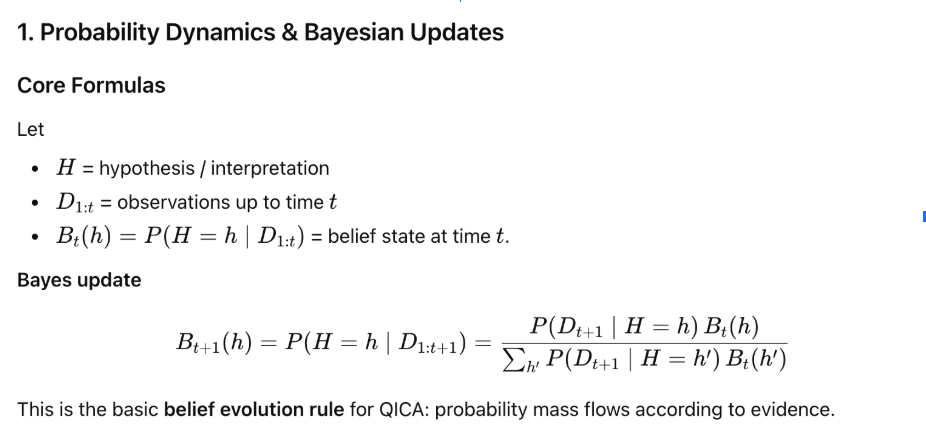
Bayesian Inference
Bayesian inference provides the mechanical backbone of belief updating in QICA. Every belief begins as a prior. New experience modifies it into a posterior.
The architecture evaluates not only whether something is likely, but also:
- how confident it is
- how stable the belief is
- how contradictory evidence affects trust
- when belief should remain undecided
This enables:
- continuous self-correction
- uncertainty-aware learning
- resilience to noise
- meaningful doubt
Probabilistic reasoning becomes native behavior, not an added layer.
Cognitive Field Theory
QICA introduces the concept of Cognitive Field Theory, a way of modeling intelligence as a spatial-temporal probability field rather than a linear algorithm.
In this model:
- knowledge behaves like a field
- cognition behaves like motion within that field
- belief behaves like localized probability density
- decisions behave like collapse events
Multiple beliefs coexist, interact, and interfere within a cognitive field. Meaning formation emerges from interactions across this field rather than from any single neuron or rule.
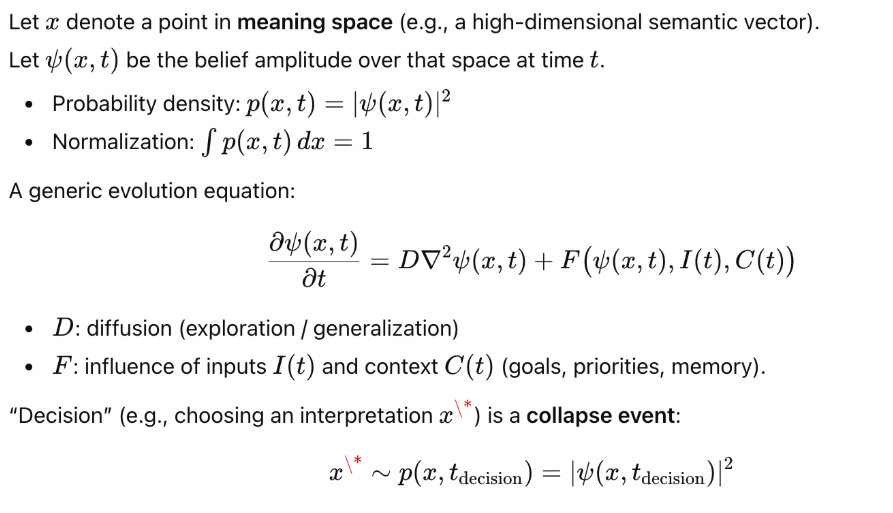
Evidence sharpens the belief field around more plausible meanings. Intelligence is therefore not a state. It is a phenomenon.
Roadmap (phases & Goals)
High-level plan (ordered phases)
- Phase 0 — Precise Formalization [Goal: Convert QICA’s architecture into explicit math and algorithms so experiments are unambiguous.]
- Phase 1 — Minimal Software Prototype (PPGN simulator) [Goal: Implement a small, documented PPGN network in software to test belief dynamics.]
- Phase 2 — Cognitive Tests in Simulation [Goal: Run basic experiments that demonstrate unique behavior vs. baselines.]
- Phase 3 — Priority / CPL Ablation Studies [Goal: Prove benefit of priority gating and CPL learning.]
- Phase 4 — Neuromorphic Mapping & Small-scale Hardware Tests [Goal: Validate PPGN dynamics on event-driven substrates; measure energy/latency tradeoffs.]
- Phase 5 — Psychological Validity Experiments [Goal: Show the architecture reproduces known human decision patterns (order effects, interference, confidence/RT relationships).]
- Phase 6 — Integrated System Demonstrator & Benchmarks [Goal: Build a multi-component demo that combines PPGN reasoning, CPL learning, priority gating, and neuromorphic execution in a small embodied task.]
- Phase 7 — Publication / Reproducible Release [Goal: Publish a sequence of papers targeting incremental venues]
Limitations and Open Challenges
QICA faces several challenges:
- Computational overhead of belief representations
- Need for formal benchmarks and metrics
- Risk of misinterpreting quantum inspiration as physical dependency
- Integration complexity with existing ML pipelines
These limitations are acknowledged as active research areas.
Pseudocode (high-level)
PYTHON:
def ppgn_forward(x, prior, priority):
# compute likelihood (task-specific)
likelihood = compute_likelihood(x)
# posterior before normalization
posterior_unnorm = likelihood * prior * exp(priority – uncertainty_penalty(prior))
posterior = posterior_unnorm / sum(posterior_unnorm)
return posterior
def CPL_update(prior, posterior, eta):
# belief increment toward posterior
new_belief = prior + eta * (posterior – prior)
# optionally regularize entropy
new_belief = entropy_regulation(new_belief)
return normalize(new_belief)
================================================================
QICA, Mathematical Foundations (Clean LaTeX Version)
================================================================
\section{Mathematical Foundations of QICA}
\subsection{Entropy of a Belief Distribution}
Let $B_t(h)$ denote the belief distribution at time $t$ over hypotheses $h$.
The entropy of this distribution is
\begin{equation}
H(B_t) = – \sum_{h} B_t(h)\, \log B_t(h).
\end{equation}
QICA does not attempt to minimize entropy blindly. Instead, it seeks to:
\begin{itemize}
\item reduce \emph{unwarranted} entropy (i.e., noise-driven uncertainty),
\item preserve entropy where the world is genuinely ambiguous.
\end{itemize}
A regularized objective for a Probabilistic \& Priority-Gated Neuron (PPGN) at time $t$ is
\begin{equation}
\mathcal{L}_t
- \log P(D_{t+1} \mid B_t)
+
\lambda \bigl(H(B_t) – H^{*}\bigr)^2,
\label{eq:loss}
\end{equation}
where $H^*$ is the target entropy level and $\lambda$ controls the strength of entropy regulation.
% ================================================================
\subsection{Belief Amplitudes in Meaning Space}
Let $x$ denote a point in a continuous \emph{meaning space} (e.g., a semantic vector space).
Define $\psi(x,t)$ as the belief amplitude at time $t$.
The corresponding probability density is
\begin{equation}
p(x,t) = |\psi(x,t)|^2,
\qquad
\text{with}
\qquad
\int p(x,t)\,dx = 1.
\end{equation}
A generic evolution equation for $\psi$ is
\begin{equation}
\frac{\partial \psi(x,t)}{\partial t}
D \nabla^{2}\psi(x,t)
+
F!\left(\psi(x,t),\, I(t),\, C(t)\right),
\label{eq:psi-evolution}
\end{equation}
where
\begin{itemize}
\item $D$ is a diffusion coefficient controlling exploration/generalization,
\item $I(t)$ represents incoming sensory evidence,
\item $C(t)$ represents contextual factors such as goals, priorities, and memory.
\end{itemize}
A “decision” (selection of an interpretation $x^{*}$) corresponds to a collapse event:
\begin{equation}
x^{*} \sim p(x,t_{\mathrm{decision}}) = |\psi(x,t_{\mathrm{decision}})|^2.
\end{equation}
% ================================================================
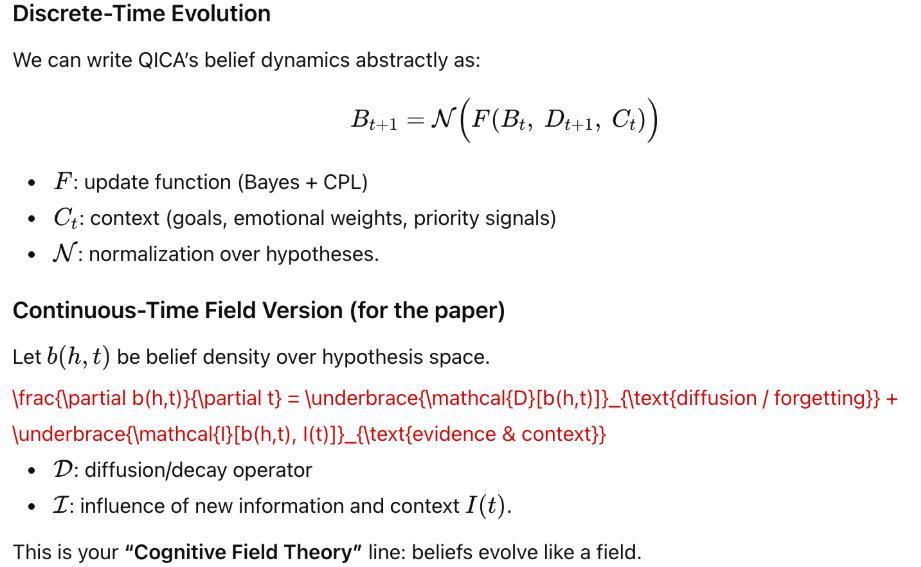
\subsection{Discrete-Time Belief Evolution}
In discrete time, belief dynamics can be written abstractly as
\begin{equation}
B_{t+1}
\mathcal{N}!\left(
F!\left(B_t,\; D_{t+1},\; C_t\right)
\right),
\label{eq:discrete-belief}
\end{equation}
where
\begin{itemize}
\item $F$ is the update function implementing Bayesian evidence integration and Cognitive Plasticity Learning (CPL),
\item $C_t$ denotes context (goals, emotional weights, priority signals),
\item $\mathcal{N}$ is a normalization operator:
[
\bigl(\mathcal{N}(z)\bigr)(h)
=
\frac{z(h)}{\sum_{h’} z(h’)}.
]
\end{itemize}
% ================================================================
\subsection{Continuous-Time Cognitive Field Equation}
Let $b(h,t)$ denote a continuous belief density over hypothesis space.
We propose the following general cognitive field dynamics:
\begin{equation}
\frac{\partial b(h,t)}{\partial t}
\underbrace{\mathcal{D}[\,b(h,t)\,]}{\text{diffusion / forgetting}} \;+\; \underbrace{\mathcal{I}[\,b(h,t),\, I(t)\,]}{\text{evidence \& context}}.
\label{eq:field-dynamics}
\end{equation}
Here,
\begin{itemize}
\item $\mathcal{D}$ is a diffusion/decay operator promoting generalization or forgetting,
\item $\mathcal{I}$ injects information from new evidence $I(t)$ and context $C(t)$ into the belief distribution.
\end{itemize}
Discretizing~\eqref{eq:field-dynamics} via forward Euler yields the form in
Equation~\eqref{eq:discrete-belief}, linking the continuous-time field model to QICA’s discrete belief updates.
% ================================================================
Conclusion & Closure
QICA proposes a shift from purely statistical AI systems toward belief-centric architectures capable of operating coherently under uncertainty. By treating belief and priority as core architectural elements, QICA offers a principled framework for advancing AI beyond reactive pattern matching.
This whitepaper presents QICA as an open research architecture, inviting scrutiny, experimentation, and refinement by the broader AI and cognitive science communities.
QICA exists because intelligence must be designed, not scaled. Not manufactured, but architected. Not copied, but constructed.
The future of AI will not be measured in parameters or processing speed, but in depth of reasoning, stability of belief, and capacity for meaning. QICA is our commitment to that future, and this document is its first architectural trace.
Academic References
AI & Cognitive Architecture
- Marcus, G. (2020). The Next Decade in AI.
- Lake, B., Ullman, T., Tenenbaum, J., Gershman, S. (2017). Building Machines That Learn and Think Like People.
- Laird, J. (2012). The Soar Cognitive Architecture.
- Anderson, J. R. (2007). How Can the Human Mind Occur in the Physical Universe?
Quantum Cognition
- Busemeyer, J., & Bruza, P. (2012). Quantum Models of Cognition and Decision.
- Haven, E., & Khrennikov, A. (2013). Quantum Social Science.
- Pothos, E., & Busemeyer, J. (2020). Quantum Cognition in Decision Theory.
Neuroscience & Biological Inspiration
- Doya, K. (2002). Metalearning and Neuromodulation.
- Aston-Jones, G., & Cohen, J. (2005). Adaptive Gain and the Locus Coeruleus-Norepinephrine System.
- Schultz, W. (2015). Dopamine Reward Prediction Error Signals.
- Ma, W., Beck, J., Latham, P., Pouget, A. (2006). Bayesian Population Coding.
Predictive Coding & Bayesian Brain
- Friston, K. (2005, 2010). Theory of Cortical Response / Free Energy Principle.
- Clark, A. (2013). Whatever Next? Predictive Brains, Situated Agents.
- Knill, D., & Pouget, A. (2004). The Bayesian Brain.
Neuromorphic Computing
- Indiveri, G., & Liu, S. (2015). Neural Computing Principles.
- Davies, M. et al. (2018). Loihi Neuromorphic Processor.
- Furber, S. (2014). SpiNNaker: Neuromorphic System Architecture.
Memory & Cognition
- Schacter, D. (2012). Constructive Memory.
- Barsalou, L. (2010). Grounded Cognition.
- Botvinick, M. et al. (2001). Conflict Monitoring and ACC.
Machine Learning Theory
- Tenenbaum, J. et al. (2011). How to Grow a Mind.
- Ghahramani, Z. (1998). Bayesian Learning in Dynamic Systems.
- Shannon, C. (1948). Mathematical Theory of Communication.
Busemeyer, J. R., & Bruza, P. D. (2012). Quantum Models of Cognition and Decision. — foundational review of quantum probability for cognition. jbusemey.pages.iu.edu
Davies, M., Orchard, G., et al. (2018). Loihi: A Neuromorphic Manycore Processor with On-Chip Learning. — state-of-the-art neuromorphic processor survey & results. Redwood Neuroscience Center
Indiveri, G., & Liu, S.-C. (2015). Memory and information processing in neuromorphic systems. — overview of neuromorphic principles. arXiv
Marković, D., et al. (2020). Quantum neuromorphic computing (perspective / arXiv). — outlines paradigms for combining quantum and neuromorphic ideas. arXiv
Jha, R. K., et al. (2025). A hybrid spiking neural network – quantum framework for … (EPJ Quantum Technology) — hybrid SNN + quantum kernel application to EEG/spatio-temporal data. SpringerLink
(Supplementary) Recent arXiv/IEEE works showing stochastic quantum-spiking hybrids and QSNN variants. arXiv+1
FAQ
What is the neural correlate of priority?(Dopamine? Gain control? Attention? Neuromodulators?)
Priority in QICA corresponds to biological salience systems, including dopaminergic reward signaling, noradrenergic gain control, cholinergic precision modulation, and attention networks, but is implemented as an engineering abstraction that unifies these effects under a single computational construct.
How does a probability field relate to rate coding, temporal coding, and population codes?
A probability field is not an exotic new code. It is an engineering formalization of Bayesian population coding, where likelihoods, uncertainties, and belief strength are represented across neural ensembles.
Biology often approximates: Probability ≈ firing rate distribution across neurons
QICA formalizes it as: Belief ≈ structured probability field
Meaning:
- Activity becomes probability mass
- Networks exchange belief, not just signal
- Learning reshapes distributions, not just weights
QICA treats neural codes as probabilistic fields in the same way physics treats temperature as an emergent field from particle motion. This is not rejection of rate coding, it is its unification.
Where is this biologically implemented?
We are not attempting anatomical mirroring. QICA models functional equivalence, not biological replication, just as artificial neurons abstract from neurons without implementing ion channels
This sounds like philosophy, not science.
QICA is not philosophical speculation. It is an architectural hypothesis grounded in probability theory, neuromorphic engineering, cognitive science, and Bayesian inference. The claims are testable through metrics such as belief stability, entropy dynamics, contradiction handling, and uncertainty calibration. This work proposes testable cognition engineering, not speculative AI metaphysics.
There is no biological evidence for ‘belief fields’.
The term “belief field” is an engineering abstraction analogous to how biology uses “electric field” or “receptive field”. It does not imply a literal physical structure, but a distributed probabilistic representation supported by population coding, predictive processing, and Bayesian inference, all of which are mainstream in neuroscience.
This is just standard Bayesian inference with grand language.
QICA extends Bayesian inference from passive prediction into active belief stabilization, priority weighting, contradiction tolerance, and memory-dependent evolution, capabilities not native to classical Bayesian systems or LLM architectures.
Where is the evidence this system is more intelligent?
Intelligence is not evaluated solely by output accuracy. QICA is evaluated through:
– belief persistence
– uncertainty coherence
– contradiction detection
– memory integration
– stability over time
These define cognitive robustness, not just pattern correctness.
Cognition’ is vague.
In this work, cognition is operationally defined as the system’s ability to:
- internalize experience over time
- maintain internal belief states
- update beliefs under uncertainty
- reduce entropy without collapse
- preserve conceptual structure
Neuromorphic hardware is immature.
All transformative hardware technologies were once immature. Neuromorphic systems are progressing in analog computing, energy efficiency, and plasticity that digital systems inherently lack. QICA acknowledges hardware constraints but proposes a future-facing architectural direction rather than claiming immediate large-scale deployment.
Emotions in machines, that is unscientific.
QICA does not claim subjective emotion. It models functional emotional weighting — priority mechanisms equivalent to salience, reinforcement, and valuation in biological cognition.
This is just consciousness cosplay.
QICA is not a theory of consciousness. It is a theory of cognitive architecture, belief states, uncertainty regulation, memory dynamics, and decision coherence.
This isn’t falsifiable.
QICA is falsifiable if:
- entropy does not diverge from classical models
- belief stability cannot be shown
- contradiction tolerance cannot be measured
- uncertainty calibration is not demonstrable
- memory persistence cannot be tested
Where are benchmarks?
There are currently no standardized benchmarks for internal cognition. QICA proposes a framework for constructing such metrics:
- contradiction survival analysis
- epistemic stability
- belief drift rates
- uncertainty calibration curves
This has no current implementation.
QICA is a systems architecture paper, not a product announcement. Architectures precede implementations by necessity, as CPUs preceded software ecosystems.
This violates Occam’s Razor.
Simpler models are not better if they fail to model the phenomenon. Cognition is not simple. Intelligent systems require structural complexity, not parameter growth.
Is this artificial general intelligence?
No. QICA is not AGI. It is a cognitive substrate framework capable of supporting adaptive, experience-based intelligence over time.