A Case Study on AI Search Hallucinations, Entity Confusion, and Dangerous Confidence.
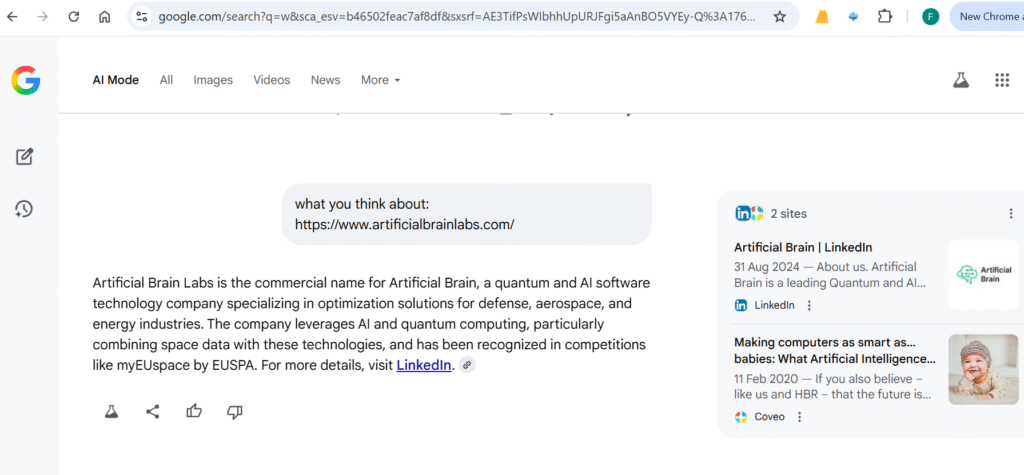
I recently asked Google’s AI Mode a simple question:
“What do you think about this website: https://www.artificialbrainlabs.com/”
The AI responded… About a completely different company.
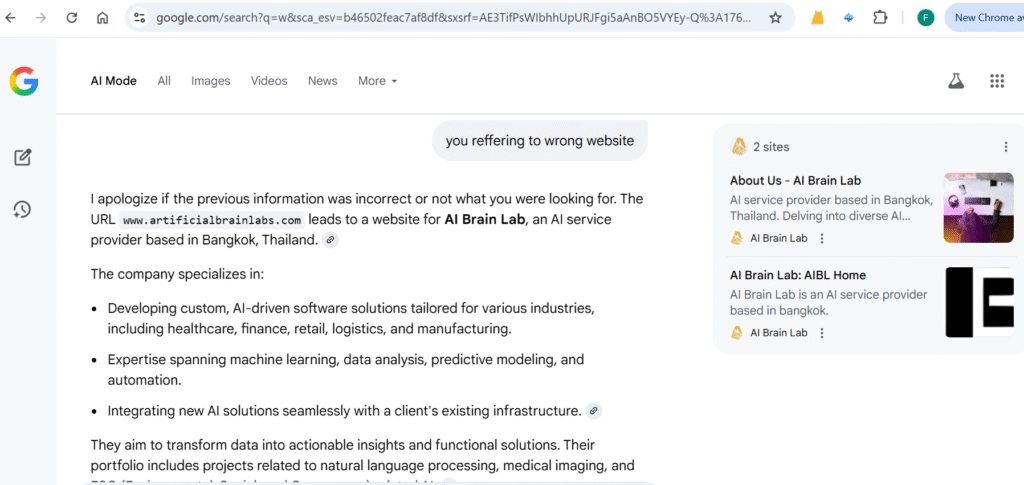
When I pointed out that the answer was wrong, it apologized, and then repeated the same mistake again. It continued describing another organization with a similar name but a different domain, different identity, and different content.
This isn’t a harmless glitch.
This is a structural weakness in how Google’s AI systems understand the web.
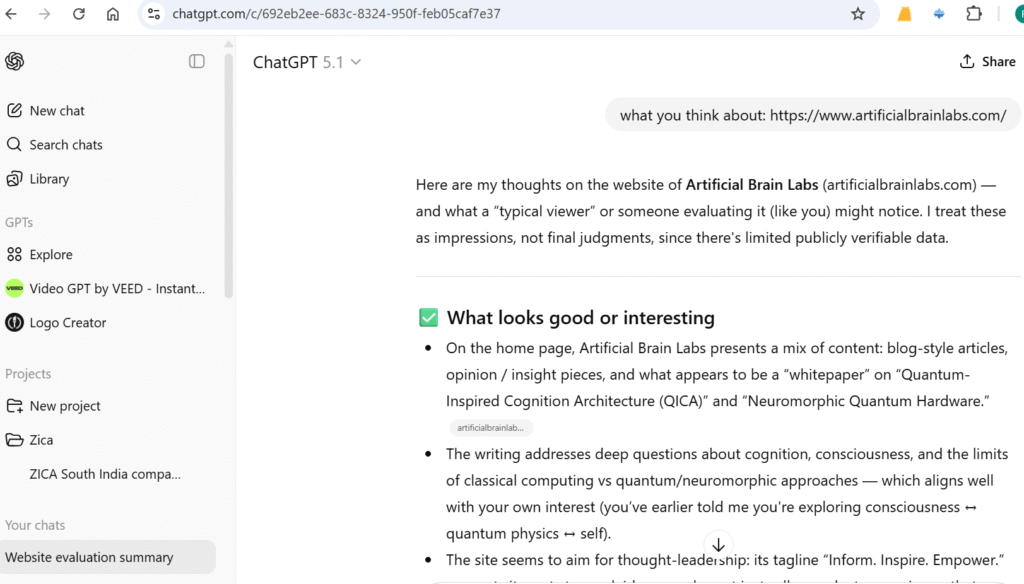
I asked the same question to ChatGPT to check whether this was a common AI mistake or if Google was missing something, which I honestly never expected from a company that had already indexed the website.
(Note: My website was registered only in October 2025, but it’s already indexed well in Google’s database.)
Surprisingly, ChatGPT scanned through my website and explained its understanding, which was really impressive.
The Incident: What Exactly Went Wrong?
The website in question:
artificialbrainlabs.com – a content-driven site exploring AI, cognition, quantum intelligence and philosophy.
What Gemini AI responded with:
A mashup of a different “Artificial Brain” brand, likely from another domain such as:
- artificialbrain.us
- or similar SEO-dominant company sites
Even after correction, it kept overlaying its answer on the wrong entity, hallucinating credibility, context, and ownership.
Root Cause 1: Entity Collision in Google’s AI Systems
Gemini does not actually “visit websites” the way humans or even ChatGPT do. Instead, it relies on embeddings, entity graphs, approximate matching, and probabilistic ranking to interpret queries. So when I mentioned “Artificial Brain Labs,” the model likely thought, “That sounds similar to Artificial Brain, which refers to this known entity…” As a result, it collapsed multiple unrelated websites into a single semantic identity. This phenomenon is known as entity collision, when distinct real-world entities are mistakenly treated as the same object by an AI system.
Root Cause 2: Gemini’s Output Suggests Ongoing Bias
This experiment with Google’s AI search system shows that it is still biased and heavily influenced by traditional SEO signals. On the other hand, GPT uses a far more neutral and semantically driven approach.
As of December 2025, heading into 2026, Gemini still prioritizes factors like:
- backlink strength
- search frequency
- domain authority
- content repetition across the web
This means websites with strong SEO dominance can overshadow smaller or niche domains. Not because they are more accurate. But simply because they are louder.
As a result, search gravity begins to outweigh factual grounding.
This contrast forces us to rethink how these two AI giants operate, and what it means for the future of information discovery.
Root Cause 3: Apology Without Correction
This is the most concerning part. Gemini apologized, yet acknowledged nothing specific and proceeded to repeat the same incorrect answer. This creates a dangerous illusion of trust: when an AI admits fault, users naturally assume it has corrected itself. But in reality, no internal state changes, no factual update occurs, and no learning takes place. What we witness is not self-correction, it’s conversational mimicry. The system behaves politely while remaining fundamentally unaware of its own errors, making the apology feel more like a scripted response than an actual fix.
The Technical Term: “False Grounding”
“False grounding” occurs when an AI system generates confident answers that have no real connection to an actual external source. In theory, AI models should tie their responses to verifiable information. But when an entity does not equal a specific URL, when authority is mistaken for truth, and when a correction does not trigger any real internal re-evaluation, the system produces answers that sound right while being anchored to nothing.
This results in confident, authoritative text built on zero factual grounding, a subtle but serious failure mode in Google’s AI models.
Why This Is Dangerous
This behavior goes far beyond being embarrassing, it is structurally dangerous. When an AI system collapses distinct entities or grounds answers to the wrong source, the consequences ripple across multiple domains.
Brand Identity Damage
Companies, creators, or personal projects can be misrepresented, replaced, or overwritten.
When the AI merges identities, your brand narrative is no longer yours.
Journalism Failure
If an AI summarizes information about the wrong organization, it generates misinformation at scale. The result: distorted facts, collapsed credibility, and polluted public understanding.
Legal Risk
Consider the implications when an AI attributes:
- business claims
- investment statements
- performance metrics
- accusations or controversies
…to the wrong entity entirely.
Now imagine this happening at scale, millions of queries, millions of incorrect impressions.
This is why the issue is not cosmetic; it’s systemic and demands correction at the model level.
The Bigger Problem: AI Mimics Confidence Better Than Understanding
The deeper issue is that today’s AI systems are exceptionally good at sounding authoritative while lacking the mechanisms needed to verify what they say. They explain elegantly, synthesize information beautifully, and project confidence, but they do not reliably verify URLs, do not consistently disambiguate identities, and do not genuinely correct their internal reasoning when they make a mistake. What we perceive as intelligence is often nothing more than highly fluent pattern completion, wrapped in confident language. This gap between eloquence and true understanding is where the real risk lies.
Conclusion: We Are Teaching AI to Replace Truth with Confidence
Google didn’t fail because of a bug.
It failed because: It values probability more than precision.
If human users don’t notice this, AI search becomes:
- a reputation engine
- a misinformation factory
- a reality blender
And nobody notices because the language is perfect.