
BACK<<Chapter 5b – The GRI Cognitive Ontology
5.5 Canonical Cognitive Objects
The GRI Cognitive Ontology is composed of a small set of canonical cognitive objects that collectively represent every aspect of persistent cognition. These objects constitute the fundamental vocabulary of the GRI Cognitive Kernel. Every cognitive process, mathematical formulation, governance mechanism, and software implementation operates exclusively upon these canonical objects. The ontology deliberately minimizes the number of primitive objects in order to maintain architectural simplicity while supporting unlimited cognitive complexity through their interaction.
The canonical cognitive objects defined by GRI Version 1.0 are:
- Cognitive Event (Normalized Event Schema)
- Dimension Framework
- Dimension Type
- Dimension Instance
- Persistent Cognitive Graph
The following sections define the ontological role of each object.
5.5.1 Cognitive Event (Normalized Event Schema)
Definition
A Cognitive Event is the canonical transient object through which every observation enters the GRI Cognitive Kernel. It represents a normalized, observationally neutral description of an occurrence and serves as the exclusive interface contract between the Cognitive Interface Layer and persistent cognition.
Purpose
The Cognitive Event exists to separate perception from cognition. It ensures that every observation, regardless of its origin or modality, is represented using a common structure before entering the Cognitive Kernel.
Ontological Role
Within the GRI ontology, the Cognitive Event is the origin of cognitive evolution. It does not contain beliefs, trust, meaning, goals, or decisions. Instead, it provides the observational stimulus from which governed cognitive change may emerge.
Every persistent modification within GRI ultimately originates from one or more Cognitive Events.
Runtime Characteristics
- Exists only during cognitive processing.
- Enters the kernel through the Cognitive Interface Layer.
- Initiates cognitive activation.
- May instantiate or modify persistent cognition.
- Becomes part of the Persistent Cognitive Graph after governance approval.
Relationships
A Cognitive Event may be associated with:
- one or more Dimension Instances;
- one or more entities;
- previous Cognitive Events;
- future Cognitive Events;
- governance decisions.
These relationships are established only after processing by the Cognitive Kernel.
Persistence
Initially transient. Becomes persistent only after successful commitment to the Persistent Cognitive Graph.
Canonical Representation
The Cognitive Event conforms to the Normalized Event Schema (NES) defined in the GRI Object Specification.
5.5.2 Dimension Framework
Definition
The Dimension Framework is the universal structural definition from which every persistent cognitive dimension is derived. It specifies the canonical representation shared by all cognitive dimensions within GRI.
Purpose
The Dimension Framework establishes a mathematically uniform representation for persistent cognition. Rather than creating independent representations for every cognitive capability, GRI defines one universal framework capable of representing all cognitive dimensions.
Ontological Role
The Dimension Framework represents the structural foundation of cognition. It is not itself a runtime object. Instead, it defines the structural contract inherited by every Dimension Type.
Runtime Characteristics
The Dimension Framework never executes and never evolves. It exists solely as an architectural definition.
Relationships
The Dimension Framework is inherited by every Dimension Type.
Persistence
Not persistent. It is a constitutional definition rather than a runtime object.
Canonical Representation
[D=(v,;w,;σ,;C,;R,;λ)][ D = (v,;w,;\sigma,;C,;R,;\lambda) ]
This representation is mandatory for every Dimension Instance.
5.5.3 Dimension Type
Definition
A Dimension Type defines a semantic category of persistent cognition.
Examples include Goal, Belief, Trust, Curiosity, Respect, Fear, and future cognitive dimensions.
Purpose
Dimension Types specialize the Dimension Framework by defining the behavioural characteristics shared by a category of cognitive states.
Ontological Role
Dimension Types provide the semantic identity of cognition. They determine what a cognitive dimension represents without containing any evolving runtime state.
Runtime Characteristics
Dimension Types remain immutable during execution. Only their instances evolve.
Relationships
Every Dimension Type inherits the Dimension Framework and may generate one or more Dimension Instances.
Persistence
Not persistent. Dimension Types are permanent architectural definitions.
Canonical Representation
Dimension Type
↓
Dimension Instance
5.5.4 Dimension Instance
Definition
A Dimension Instance is the persistent runtime realization of a Dimension Type. Each instance represents an individual cognitive state belonging to a specific entity, concept, relationship, or experience.
Purpose
Dimension Instances constitute the actual cognitive state of the intelligent agent. They are the only objects through which cognition evolves.
Ontological Role
Dimension Instances are the primary carriers of persistent cognition. Every belief, trust relationship, goal, fear, curiosity, and future cognitive state exists as a Dimension Instance.
Runtime Characteristics
Dimension Instances:
- evolve continuously;
- participate in governance;
- maintain relationships;
- preserve learning history;
- influence future cognition.
Relationships
Dimension Instances are associated with:
- Cognitive Events;
- other Dimension Instances;
- entities;
- goals;
- the Persistent Cognitive Graph.
Persistence
Persistent throughout the lifetime of the intelligent agent unless constitutionally removed.
Canonical Representation
Every Dimension Instance conforms to the Dimension Framework and inherits the behavioural characteristics of its corresponding Dimension Type.
5.5.5 Persistent Cognitive Graph
Definition
The Persistent Cognitive Graph (PCG) is the canonical repository of persistent cognition within GRI. It represents the continuously evolving cognitive identity of the intelligent agent.
Purpose
The PCG preserves the complete history and current state of persistent cognition. It enables lifelong memory, cognitive continuity, relationship evolution, and recursive learning.
Ontological Role
The Persistent Cognitive Graph is the authoritative realization of cognition. All persistent cognitive objects ultimately reside within the PCG.
Runtime Characteristics
The PCG continuously evolves as governed Cognitive Events modify Dimension Instances and their relationships. It remains active throughout the lifetime of the intelligent agent.
Relationships
The PCG maintains relationships among:
- Cognitive Events;
- Dimension Instances;
- entities;
- goals;
- temporal histories;
- governance records.
Persistence
Fully persistent. The PCG represents the enduring cognitive state of the agent.
Canonical Representation
The PCG is defined as a dynamic graph of canonical cognitive objects whose structure evolves exclusively through constitutionally governed cognitive processes.
Three ontological levels
Level 1: Meta Ontology
Dimension Framework
Level 2: Ontology Definitions
Dimension Type
Level 3: Runtime Ontology
- Cognitive Event
- Dimension Instance
- Persistent Cognitive Graph
Ontology of a cognitive operating system.
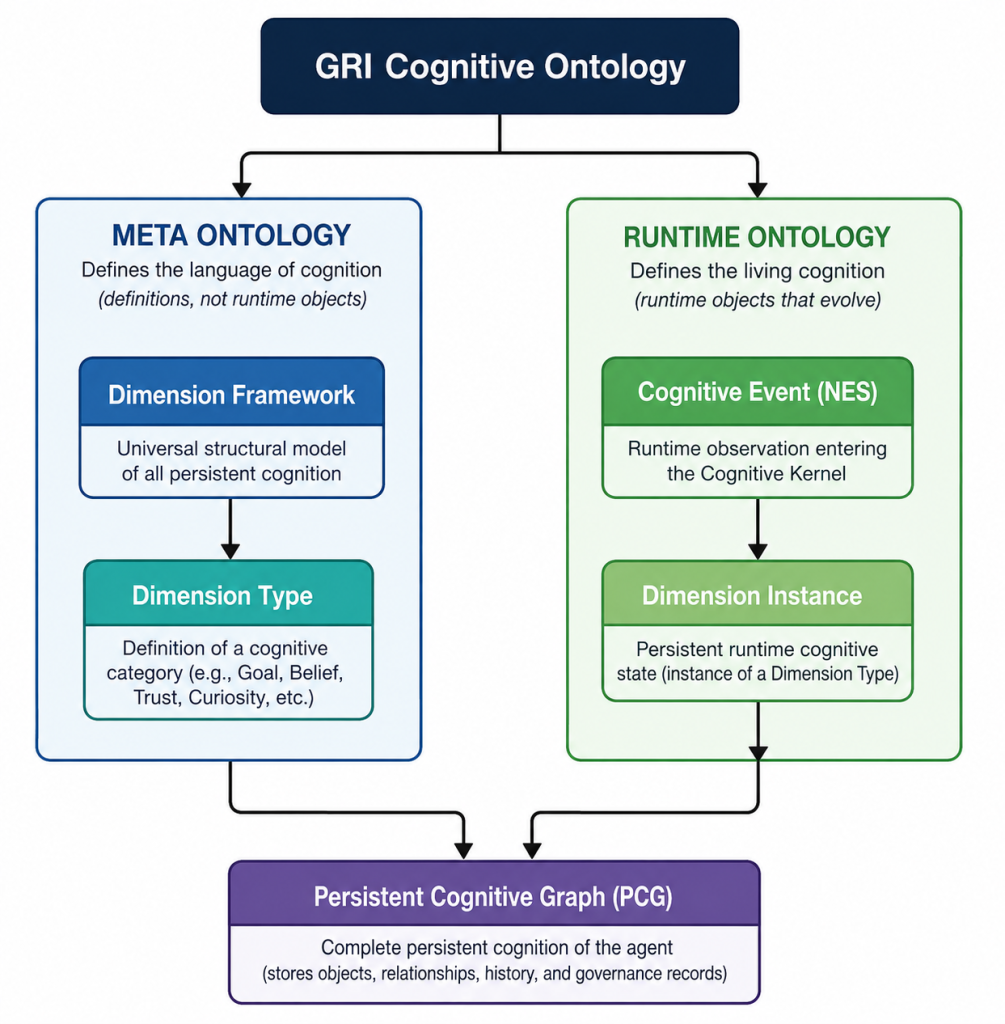
Responsibilities
Meta Ontology
- Defines the language of cognition.
Contains:
- Dimension Framework
- Dimension Types
These never evolve.
Runtime Ontology
- Defines the living cognition.
Contains:
- Cognitive Events
- Dimension Instances
- Persistent Cognitive Graph
These evolve continuously.
Section Summary
The five canonical cognitive objects defined above constitute the complete ontological vocabulary of GRI Version 1.0.
Rather than introducing separate representations for every cognitive capability, GRI explains persistent intelligence through the interaction of these five canonical objects. This unified ontology provides the conceptual and engineering foundation upon which all future mathematical models, kernel processes, governance mechanisms, simulations, and implementations are built.
NEXT>>Chapter 5d – The GRI Cognitive Ontology