
4.1 Introduction
Governed Recursive Intelligence (GRI) is designed as a complete cognitive computing architecture rather than a standalone artificial intelligence model. The architecture separates perception from cognition, cognition from decision making, and decision making from action execution. This separation enables GRI to remain independent of language, modality, hardware, and implementation technologies while preserving a stable cognitive foundation.
At the center of the architecture is the GRI Cognitive Kernel, a governance-native computational core responsible for persistent cognition, lifelong learning, constitutional governance, and recursive cognitive evolution. Surrounding the kernel are interface and execution layers that allow GRI to communicate with the external world without embedding perception directly into cognition.
This layered architecture ensures that intelligent systems can evolve continuously while maintaining cognitive consistency, modularity, and extensibility.
4.2 Architectural Philosophy
The GRI architecture is guided by the following design principles.
Simplicity
The architecture shall contain the minimum number of fundamental objects and processes required to explain persistent intelligence.
Separation of Responsibility
Each architectural layer shall perform a single primary responsibility. Perception shall remain separate from cognition. Cognition shall remain separate from execution.
Persistence
The cognitive state shall persist throughout the lifetime of the intelligent agent. No meaningful interaction shall be processed in isolation.
Governance
Every persistent cognitive transition shall be constitutionally governed before becoming part of the agent’s enduring cognitive state.
Extensibility
Future perception technologies, language models, reasoning systems, robotic platforms, and computational capabilities shall be integrated without requiring modifications to the Cognitive Kernel.
4.3 System Architecture
The GRI architecture consists of six logical layers.
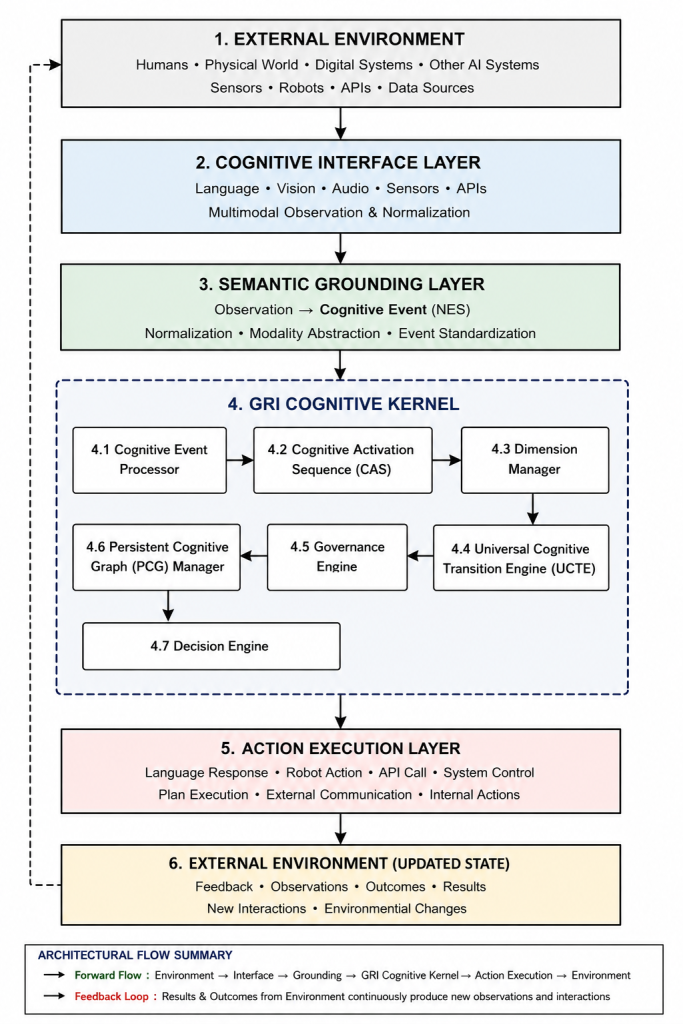
Together these layers define the complete architectural boundary of GRI.
4.4 External Environment
The External Environment represents every source capable of generating observations or receiving actions from the intelligent agent.
Examples include:
-
- Humans
-
- Physical environments
-
- Digital systems
-
- Robots
-
- Sensors
-
- Other AI systems
-
- Internal cognitive processes
The environment itself is not part of cognition. It is the source and destination of interactions.
4.5 Cognitive Interface Layer
The Cognitive Interface Layer enables communication between the environment and the Cognitive Kernel.
Its responsibilities include:
-
- language processing,
-
- vision processing,
-
- speech processing,
-
- sensor integration,
-
- API integration,
-
- multimodal perception.
The Cognitive Interface Layer performs observation and normalization. It does not perform persistent cognition.
4.6 Semantic Grounding Layer
The Semantic Grounding Layer converts observations into standardized Cognitive Events conforming to the Normalized Event Schema (NES).
Its responsibilities include:
-
- observation normalization,
-
- modality abstraction,
-
- event standardization,
-
- interface validation.
The Semantic Grounding Layer does not infer beliefs, intentions, trust, or meaning. Its responsibility is to produce a consistent cognitive interface independent of the originating modality.
4.7 GRI Cognitive Kernel
The Cognitive Kernel is the permanent cognitive core of the intelligent agent.
It is responsible for:
-
- processing Cognitive Events;
-
- activating cognitive dimensions;
-
- evolving persistent cognition;
-
- enforcing constitutional governance;
-
- maintaining lifelong memory;
-
- supporting recursive cognitive evolution.
The kernel operates independently of language, perception, hardware, and implementation technology. It accepts only standardized Cognitive Events as input.
4.8 Decision Formation Layer
Following governance and persistence, the updated cognitive state is evaluated to generate decisions.
Decision formation is guided by:
-
- the Constitutional Master Goal;
-
- active operational goals;
-
- persistent beliefs;
-
- trust relationships;
-
- cognitive history;
-
- current context.
Decision formation does not modify cognition directly. Its purpose is to determine appropriate actions based on the current persistent cognitive state.
4.9 Action Execution Layer
The Action Execution Layer converts decisions into observable behavior.
Actions may include:
-
- natural language responses;
-
- robotic movement;
-
- API execution;
-
- system control;
-
- planning outputs;
-
- internal cognitive actions.
This layer remains implementation-dependent and may vary across domains without affecting the Cognitive Kernel.
4.10 Architectural Boundaries
GRI establishes explicit boundaries between architectural responsibilities.
Outside the Cognitive Kernel
-
- Language Models
-
- Vision Systems
-
- Speech Recognition
-
- Sensors
-
- Robotics
-
- APIs
-
- External Databases
-
- Hardware Platforms
These systems provide perception and execution capabilities.
Inside the Cognitive Kernel
-
- Cognitive Events
-
- Cognitive Activation Sequence (CAS)
-
- Dimension Management
-
- Universal Cognitive Transition Engine (UCTE)
-
- Governance Engine
-
- Persistent Cognitive Graph (PCG)
-
- Decision Engine
These components constitute the persistent cognitive architecture.
4.11 Architectural Benefits
The layered architecture provides several advantages.
-
- Modality independence
-
- Language independence
-
- Hardware independence
-
- Persistent cognition
-
- Constitutional governance
-
- Lifelong learning
-
- Extensibility
-
- Reusability across domains
-
- Implementation flexibility
The architecture therefore supports a wide range of intelligent systems while preserving a single universal cognitive foundation.
Chapter Summary
The GRI System Architecture separates perception, cognition, decision making, and action into independent yet coordinated architectural layers. At its center lies the Governance-Native Cognitive Kernel, which maintains persistent cognition through governed Cognitive Events and lifelong cognitive evolution. This separation enables GRI to function as a universal cognitive foundation capable of supporting intelligent systems across diverse domains while remaining independent of language, modality, and implementation technology.
The following chapters define the canonical cognitive objects, execution model, governance mechanisms, and mathematical foundations that operate within the Cognitive Kernel.
GRI Constitutional Principle Reinforced
The GRI System Architecture separates perception from cognition, cognition from execution, and governs every persistent cognitive transition through a universal, implementation-independent Cognitive Kernel.