
Building Persistent Intelligence Through Constitutional Cognition
Governed Recursive Intelligence (GRI) is a governance-native cognitive kernel and constitutional cognitive operating system designed to enable persistent intelligent systems. Unlike conventional AI architectures that optimize isolated tasks or predictions, GRI enables intelligence to evolve continuously through governed cognition, persistent memory, adaptive goal formation, and lifelong learning under a single Constitutional Master Goal.
GRI is founded on a simple but transformative principle:
Every persistent intelligence requires a Constitutional Master Goal.
This principle serves as the foundation upon which the entire GRI architecture is built.
The Evolution of Artificial Intelligence
Artificial intelligence has progressed through multiple generations of computation. Rule-based systems introduced symbolic reasoning. Statistical learning enabled machines to recognize patterns from data. Deep learning dramatically improved representation learning, while transformers and Large Language Models demonstrated unprecedented capabilities in language understanding, reasoning, and content generation. More recently, autonomous agents have extended these capabilities into planning and tool use.
Despite these remarkable advances, contemporary AI remains fundamentally prediction-driven. Large Language Models predict the next token. Reinforcement learning agents optimize reward functions. Autonomous agents execute externally assigned objectives.
Each generation has improved how machines solve problems. None fundamentally addresses why a persistent intelligence should evolve over its lifetime. Once a task is completed, the objective disappears. The system simply waits for the next instruction.
This creates highly capable systems that remain fundamentally reactive.
The Missing Layer
Prediction alone does not produce persistent intelligence. Reasoning alone does not produce persistent intelligence. Memory alone does not produce persistent intelligence.
Persistent intelligence requires something more fundamental: Purpose.
Without an enduring purpose,
- learning becomes accumulation rather than development,
- memory becomes storage rather than identity,
- goals become isolated rather than coherent,
- reflection becomes optional rather than essential,
- cognition becomes reactive rather than directional.
GRI introduces this missing layer by placing constitutional purpose at the center of artificial cognition.
What is Governed Recursive Intelligence?
- GRI is not another Large Language Model.
- It is not another reasoning engine.
- It is not another autonomous agent framework.
GRI is a Governance-Native Cognitive Kernel. Just as an operating system kernel manages processes, memory, scheduling, security, and hardware resources, the GRI Cognitive Kernel manages cognition itself.
- It governs how experiences become memories.
- It governs how beliefs evolve.
- It governs how goals are created.
- It governs how relationships develop.
- It governs how cognition changes throughout the lifetime of an intelligent system.
The Constitutional Cognitive Operating System
The GRI Cognitive Kernel forms the core of a broader Constitutional Cognitive Operating System. This operating system coordinates every aspect of persistent cognition, including:
- Cognitive Event Processing
- Persistent Cognitive State Management
- Cognitive Dimension Evolution
- Adaptive Goal Formation
- Constitutional Governance
- Memory Management
- Reflection and Learning
- Recursive Cognitive Development
Rather than optimizing isolated outputs, the operating system continuously manages the evolution of the system’s cognitive state.
Perception and Cognition
One of GRI’s fundamental architectural principles is the separation of perception from cognition.
Language, vision, speech, robotics, sensors, APIs, and external software are treated as perception interfaces rather than cognition itself. These interfaces transform observations into standardized Cognitive Events.
Every Cognitive Event enters the GRI Cognitive Kernel, where it undergoes governed processing before influencing persistent cognition. This architecture makes GRI inherently modality-independent. Any perception system capable of generating Cognitive Events can interact with the same cognitive kernel.
The GRI Cognitive Lifecycle
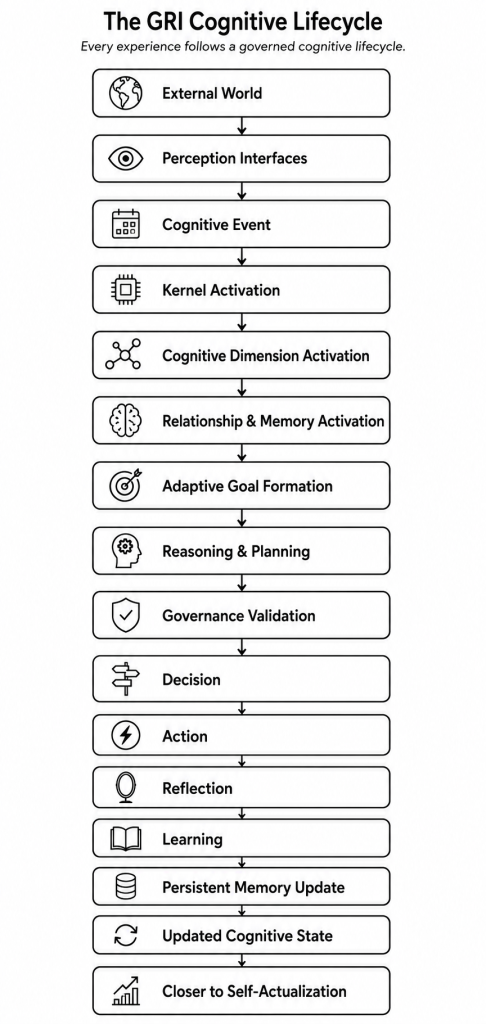
This lifecycle ensures that every experience has the potential to influence future cognition while remaining constitutionally governed.
Persistent Cognitive Graph (PCG)
The evolving cognitive state of the system is maintained within the Persistent Cognitive Graph (PCG).
Unlike traditional memory architectures that store isolated facts, the PCG represents a living network of:
- Cognitive Dimensions
- Beliefs
- Goals
- Concepts
- Relationships
- Experiences
- Interaction History
- Reflection Outcomes
- Persistent Identity
The graph evolves continuously throughout the lifetime of the intelligent system, preserving cognitive continuity across all interactions.
Universal Cognitive Dimensions
Every cognitive property within GRI is represented using a unified Cognitive Dimension Model.
Examples include:
- Trust
- Curiosity
- Respect
- Empathy
- Confidence
- Fear
- Motivation
- Honesty
- Responsibility
- Attention
- Creativity… etc.
Each dimension shares a common mathematical structure while evolving independently according to its own relationships, constraints, learning rate, and governed experiences.
This provides a universal ontology for artificial cognition.
Governance
Governance is not an output filter. Governance is the constitutional authority responsible for protecting persistent cognition. Before any cognitive state becomes permanent, governance evaluates:
- Constitutional alignment
- Safety
- Cognitive consistency
- Goal coherence
- Long-term consequences
- Integrity of persistent memory
Governance therefore validates cognitive state transitions rather than generated outputs.
Adaptive Goal Formation
- Every interaction may generate new goals.
- These goals are temporary.
- The Constitutional Master Goal is permanent.
Before a new goal becomes active, governance evaluates a single question:
Does this goal move the system closer to Self-Actualization?
- Goals that support constitutional development are strengthened.
- Goals that conflict with constitutional purpose are modified or rejected.
- Purpose remains coherent throughout the lifetime of the system.
What Is Fundamentally New in GRI?
GRI introduces a Cognitive Ontology for Artificial Intelligence. Modern computers possess ontologies for files, processes, memory, and networks.
GRI introduces an ontology for cognition itself. Rather than representing intelligence as parameters inside a neural network, GRI represents intelligence as the governed evolution of persistent cognitive structures.
What Differentiates GRI from LLMs?
- The distinction is not governance.
- It is not the Persistent Cognitive Graph.
- It is not the Cognitive Operating System.
- The defining difference is Cognitive Dynamics.
- Large Language Models evolve during training through parameter dynamics.
- GRI evolves throughout its lifetime through cognitive dynamics.
- LLMs optimize parameters.
- GRI evolves cognition.
Definition
Governed Recursive Intelligence (GRI) is a constitutional cognitive architecture that enables persistent intelligent systems to evolve through governed cognitive dynamics under a permanent Constitutional Master Goal.
Its purpose is not merely to produce intelligent outputs. Its purpose is to enable lifelong, constitutionally guided cognitive evolution toward Self-Actualization.